 Dr. Paddy Ryan, USA


Info
Randall, 1981
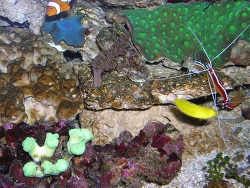
Halichoeres ist eine artenreiche Gattung der Junkerlippfische (Julidinae). Es gibt schon weit über 70 Arten bei Erstellung dieses Eintrages. Halichoeres Arten ernähren sich im Meer von Wirbellosen, wie z.B. kleinen Krebschen, Schnecken und Würmern. Die Nahrung wird daher im Aquarium oft am/im Bodengrund gesucht.
Vor allem der Haliocheres chrysus wird oftmals gerne eingesetzt, wenn man sich Montiporafressende Schnecken eingeschleppt hat.
Zur Aquarienhaltung: Ein an sich leicht zu haltender Fisch, der aber auch wirklich viel im Becken unterwegs ist und entsprechend Schwimmraum benötigt.
Mit zunehmender Größe haben manche Halichoeres- Arten oft auch Blödsinn im Kopf, was wir bei diesem Tier so aber auch nicht immer bestätigen können. Vermutlich ist es eine Sache der Beschäftigung. Es sollte daher den Lippfischen nie wirklich langweilig werden. Und das geschieht natürlich bei einem beengtem Schwimmraum eher, als in großzügigen Aquarien.
Wichtig: Benötigt unbedingt einen Sandboden, um sich abends darin einzugraben und dort zu schlafen. Ist die ersten Tage nach dem Import noch so im gewohnten Trott, dass er wie gewohnt schlafen geht, egal wie spät es ist, und ob das Licht noch an ist, oder nicht. Das gibt sich dann mit zunehmender Anpassung an den Aquarienalltag. Wer sich das Aquarium nicht voll Sand machen will, kann gerne eine Tupperschüssel nehmen und dort Sand hineingeben. Das wird auch angenommen !
Unterscheidungsmerkmale:
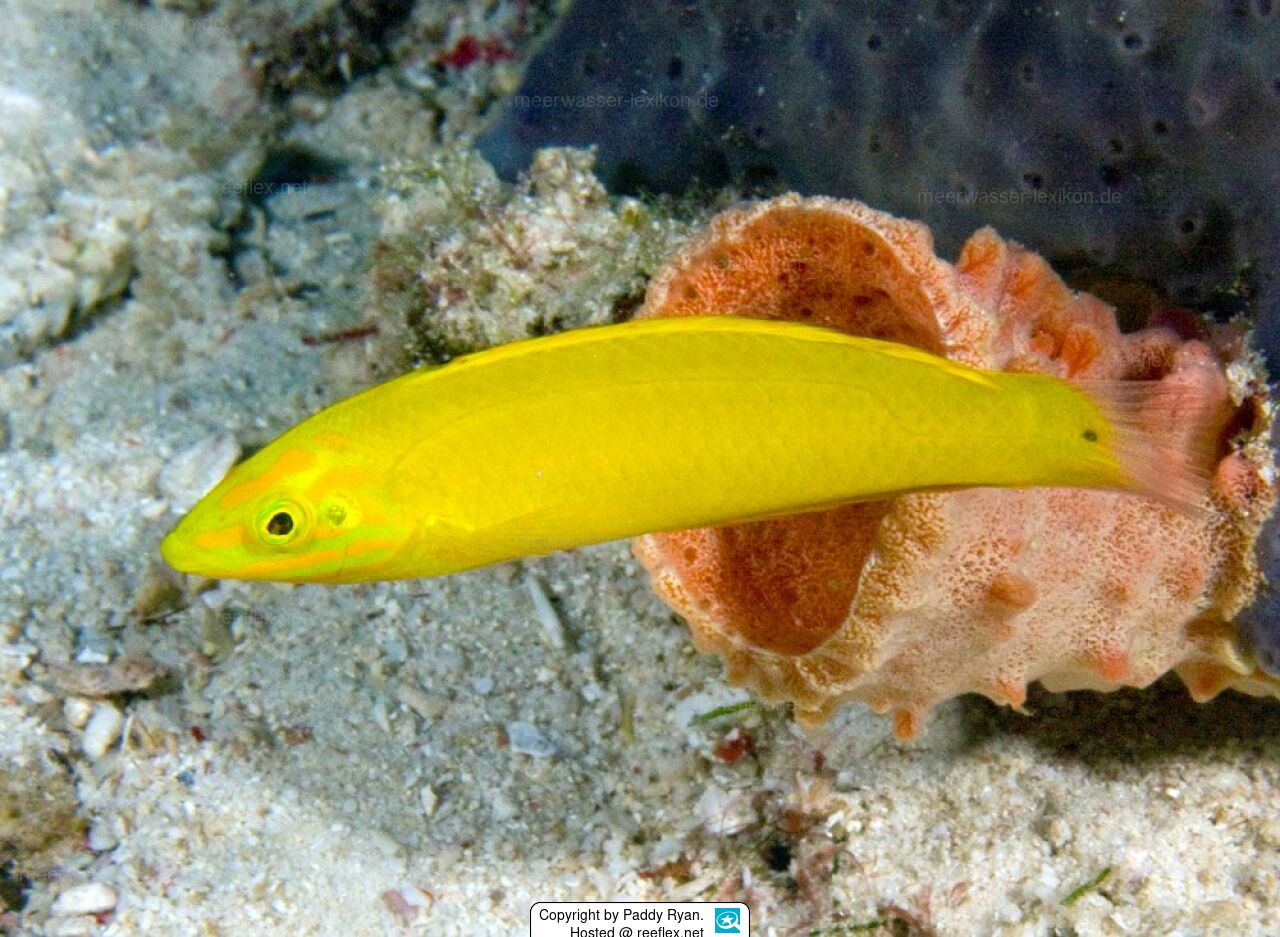
Halichoeres leucoxanthus unterscheidet sich vom Halichoeres chrysus dadurch, dass er einen weißen Unterbauch hat. Außerdem hat Halichoeres leucoxanthus in seiner Jugend zwei schwarze Punkte, die jeweils weiß eingerahmt sind, in der oberen Flosse und einen schwarzen Punkt, der weiß eingerahmt ist, in der Schwanzflosse.
ually in small groups.
The wrasse lives reef-associated in a dep range from 2 - 70 meters.
Distinguishing features:
Halichoeres leucoxanthus differs from Halichoeres chrysus in that it has a white underbelly. In addition, Halichoeres leucoxanthus has two black spots, each framed in white, in the upper fin when young and a black spot, framed in white, in the caudal fin.
Jumping guard
A jumping guard prevents (nocturnal) fish from jumping out.
Wrasses, blennies, hawkfishs and gobies jump out of an unprotected tank in fright if their night rest is disturbed, unfortunately these jumpers are found dried up in the morning on carpets, glass edges or later behind the tank.
https://www.korallenriff.de/en/article/1925_5_Jump_Protection_Solutions_for_Fish_in_the_Aquarium__5_Net_Covers.html
A small night light also helps, as it provides the fish with a means of orientation in the dark!
The term "reef safe" is often used in marine aquaristics, especially when buying a new species people often ask if the new animal is "reef safe".
What exactly does reef safe mean?
To answer this question, you can ask target-oriented questions and inquire in forums, clubs, dealers and with aquarist friends:
- Are there already experiences and keeping reports that assure that the new animal can live in other suitably equipped aquariums without ever having caused problems?
- Is there any experience of invertebrates (crustaceans, hermits, mussels, snails) or corals being attacked by other inhabitants such as fish of the same or a different species?
- Is any information known or expected about a possible change in dietary habits, e.g., from a plant-based diet to a meat-based diet?
- Do the desired animals leave the reef structure "alone", do they constantly change it (boring starfish, digger gobies, parrotfish, triggerfish) and thus disturb or displace other co-inhabitants?
- do new animals tend to get diseases repeatedly and very quickly and can they be treated?
- Do known peaceful animals change their character in the course of their life and become aggressive?
- Can the death of a new animal possibly even lead to the death of the rest of the stock through poisoning (possible with some species of sea cucumbers)?
- Last but not least the keeper of the animals has to be included in the "reef safety", there are actively poisonous, passively poisonous animals, animals that have dangerous biting or stinging weapons, animals with extremely strong nettle poisons, these have to be (er)known and a plan of action should have been made in advance in case of an attack on the aquarist (e.g. telephone numbers of the poison control center, the treating doctor, the tropical institute etc.).
If all questions are evaluated positively in the sense of the animal(s) and the keeper, then one can assume a "reef safety".
Halichoeres ist eine artenreiche Gattung der Junkerlippfische (Julidinae). Es gibt schon weit über 70 Arten bei Erstellung dieses Eintrages. Halichoeres Arten ernähren sich im Meer von Wirbellosen, wie z.B. kleinen Krebschen, Schnecken und Würmern. Die Nahrung wird daher im Aquarium oft am/im Bodengrund gesucht.
Vor allem der Haliocheres chrysus wird oftmals gerne eingesetzt, wenn man sich Montiporafressende Schnecken eingeschleppt hat.
Zur Aquarienhaltung: Ein an sich leicht zu haltender Fisch, der aber auch wirklich viel im Becken unterwegs ist und entsprechend Schwimmraum benötigt.
Mit zunehmender Größe haben manche Halichoeres- Arten oft auch Blödsinn im Kopf, was wir bei diesem Tier so aber auch nicht immer bestätigen können. Vermutlich ist es eine Sache der Beschäftigung. Es sollte daher den Lippfischen nie wirklich langweilig werden. Und das geschieht natürlich bei einem beengtem Schwimmraum eher, als in großzügigen Aquarien.
Wichtig: Benötigt unbedingt einen Sandboden, um sich abends darin einzugraben und dort zu schlafen. Ist die ersten Tage nach dem Import noch so im gewohnten Trott, dass er wie gewohnt schlafen geht, egal wie spät es ist, und ob das Licht noch an ist, oder nicht. Das gibt sich dann mit zunehmender Anpassung an den Aquarienalltag. Wer sich das Aquarium nicht voll Sand machen will, kann gerne eine Tupperschüssel nehmen und dort Sand hineingeben. Das wird auch angenommen !
Unterscheidungsmerkmale:
Halichoeres leucoxanthus unterscheidet sich vom Halichoeres chrysus dadurch, dass er einen weißen Unterbauch hat. Außerdem hat Halichoeres leucoxanthus in seiner Jugend zwei schwarze Punkte, die jeweils weiß eingerahmt sind, in der oberen Flosse und einen schwarzen Punkt, der weiß eingerahmt ist, in der Schwanzflosse.
ually in small groups.
The wrasse lives reef-associated in a dep range from 2 - 70 meters.
Distinguishing features:
Halichoeres leucoxanthus differs from Halichoeres chrysus in that it has a white underbelly. In addition, Halichoeres leucoxanthus has two black spots, each framed in white, in the upper fin when young and a black spot, framed in white, in the caudal fin.
Jumping guard
A jumping guard prevents (nocturnal) fish from jumping out.
Wrasses, blennies, hawkfishs and gobies jump out of an unprotected tank in fright if their night rest is disturbed, unfortunately these jumpers are found dried up in the morning on carpets, glass edges or later behind the tank.
https://www.korallenriff.de/en/article/1925_5_Jump_Protection_Solutions_for_Fish_in_the_Aquarium__5_Net_Covers.html
A small night light also helps, as it provides the fish with a means of orientation in the dark!
The term "reef safe" is often used in marine aquaristics, especially when buying a new species people often ask if the new animal is "reef safe".
What exactly does reef safe mean?
To answer this question, you can ask target-oriented questions and inquire in forums, clubs, dealers and with aquarist friends:
- Are there already experiences and keeping reports that assure that the new animal can live in other suitably equipped aquariums without ever having caused problems?
- Is there any experience of invertebrates (crustaceans, hermits, mussels, snails) or corals being attacked by other inhabitants such as fish of the same or a different species?
- Is any information known or expected about a possible change in dietary habits, e.g., from a plant-based diet to a meat-based diet?
- Do the desired animals leave the reef structure "alone", do they constantly change it (boring starfish, digger gobies, parrotfish, triggerfish) and thus disturb or displace other co-inhabitants?
- do new animals tend to get diseases repeatedly and very quickly and can they be treated?
- Do known peaceful animals change their character in the course of their life and become aggressive?
- Can the death of a new animal possibly even lead to the death of the rest of the stock through poisoning (possible with some species of sea cucumbers)?
- Last but not least the keeper of the animals has to be included in the "reef safety", there are actively poisonous, passively poisonous animals, animals that have dangerous biting or stinging weapons, animals with extremely strong nettle poisons, these have to be (er)known and a plan of action should have been made in advance in case of an attack on the aquarist (e.g. telephone numbers of the poison control center, the treating doctor, the tropical institute etc.).
If all questions are evaluated positively in the sense of the animal(s) and the keeper, then one can assume a "reef safety".