


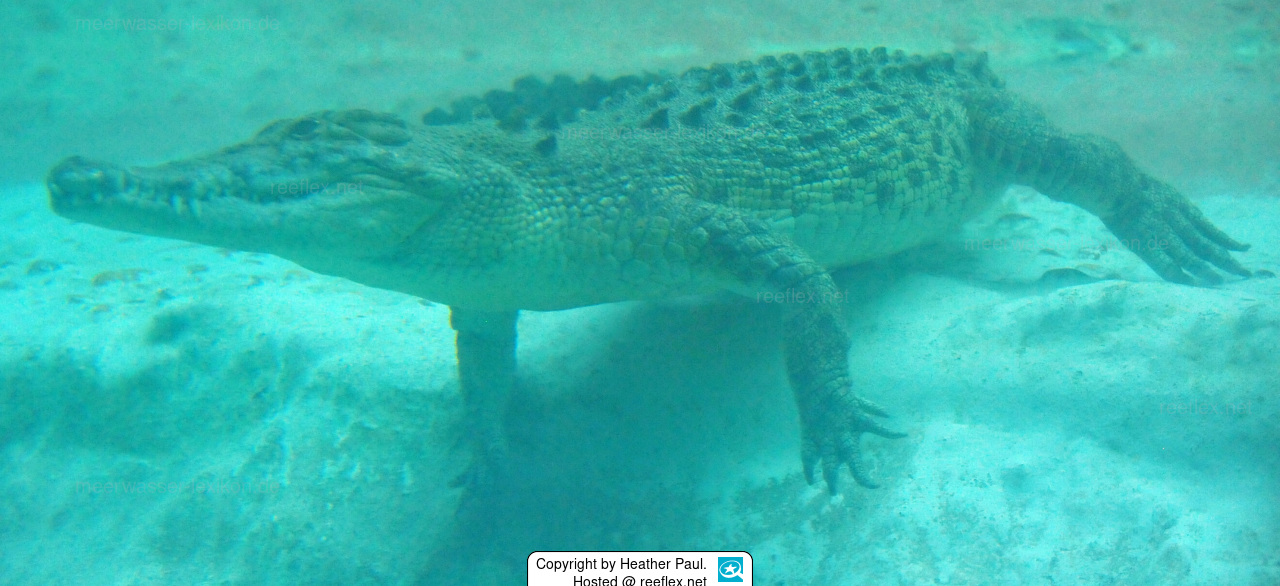
 Heather Paul, USA

Info
Crocodylus porosus Schneider, 1801
Under optimal conditions, the great white shark can reach a size of 6 meters, the male saltwater crocodile can grow even a whole meter larger, and the sea is its home.
Freshly hatched baby crocodiles find not only the ideal place to hide from predators in mangroves, but also their first food, especially insects.
At around one year old, small fish such as mudskippers are on the menu, which becomes more extensive as the reptiles grow.
At around one year old, small fish such as mudskippers are on the menu, which becomes more extensive as the reptiles grow.
From fish, seabirds, snakes, other smaller crocodiles to the increasingly rare dugongs (Dugong dugon), everything is grabbed, drowned, torn apart by the so-called death roll, and swallowed.
The press repeatedly reports that careless or overconfident people who ignore safety signs prohibiting swimming, for example, fall victim to these large reptiles.
Even though the saltwater crocodile is at home in the sea, it also likes to live in the immediate vicinity of estuaries, hence its second name “estuarine.”
Similar to the bull shark (Carcharhinus leucas), saltwater crocodiles have also been sighted several times more than 100 km upstream in rivers!
The saltwater crocodile has a bite force of 12,740 newtons per square centimeter (N cm−2), which is ~1.3 tons; only the great white shark has a stronger bite force of 17,640 newtons per square centimeter, ~1.8 tons!
The great white shark and the saltwater crocodile also face each other as adversaries in the sea. In South Africa in 2013, a large saltwater crocodile head was found on a beach, and bite marks showed that the reptile's head had been bitten off by a great white shark.
You can find lots more interesting information about “salties” by clicking on the link “Australia's animals.”
The saltwater crocodile is listed under CITES I. Upon request, a breeding facility in Thailand was granted CITES II approval for this species. They take refuge from predators here and also consume their first food, especially insects.
At around one year of age, small fish such as mudskippers are added to the diet, which becomes more extensive as the reptiles grow.
From fish, seabirds, snakes, other smaller crocodiles to the increasingly rare dugongs (Dugong dugon), everything is grabbed, drowned, torn apart by the so-called death roll, and swallowed.
The press repeatedly reports that careless or overconfident people who ignore safety signs prohibiting swimming, for example, fall victim to these large reptiles.
Even though the saltwater crocodile is at home in the sea, it also likes to live in the immediate vicinity of estuaries, hence its second name, “estuarine.”
Similar to the bull shark (Carcharhinus leucas), saltwater crocodiles have also been sighted several times more than 100 km upstream in rivers!
The saltwater crocodile has a bite force of 12,740 newtons per square centimeter (N cm−2), which is ~1.3 tons. Only the great white shark has a stronger bite force of 17,640 newtons per square centimeter, ~1.8 tons!
The great white shark and the saltwater crocodile also face each other as opponents in the sea.
Under optimal conditions, the great white shark can reach a size of 6 meters, the male saltwater crocodile can grow even a whole meter larger, and the sea is its home.
Freshly hatched baby crocodiles find not only the ideal place to hide from predators in mangroves, but also their first food, especially insects.
At around one year old, small fish such as mudskippers are on the menu, which becomes more extensive as the reptiles grow.
At around one year old, small fish such as mudskippers are on the menu, which becomes more extensive as the reptiles grow.
From fish, seabirds, snakes, other smaller crocodiles to the increasingly rare dugongs (Dugong dugon), everything is grabbed, drowned, torn apart by the so-called death roll, and swallowed.
The press repeatedly reports that careless or overconfident people who ignore safety signs prohibiting swimming, for example, fall victim to these large reptiles.
Even though the saltwater crocodile is at home in the sea, it also likes to live in the immediate vicinity of estuaries, hence its second name “estuarine.”
Similar to the bull shark (Carcharhinus leucas), saltwater crocodiles have also been sighted several times more than 100 km upstream in rivers!
The saltwater crocodile has a bite force of 12,740 newtons per square centimeter (N cm−2), which is ~1.3 tons; only the great white shark has a stronger bite force of 17,640 newtons per square centimeter, ~1.8 tons!
The great white shark and the saltwater crocodile also face each other as adversaries in the sea. In South Africa in 2013, a large saltwater crocodile head was found on a beach, and bite marks showed that the reptile's head had been bitten off by a great white shark.
You can find lots more interesting information about “salties” by clicking on the link “Australia's animals.”
The saltwater crocodile is listed under CITES I. Upon request, a breeding facility in Thailand was granted CITES II approval for this species. They take refuge from predators here and also consume their first food, especially insects.
At around one year of age, small fish such as mudskippers are added to the diet, which becomes more extensive as the reptiles grow.
From fish, seabirds, snakes, other smaller crocodiles to the increasingly rare dugongs (Dugong dugon), everything is grabbed, drowned, torn apart by the so-called death roll, and swallowed.
The press repeatedly reports that careless or overconfident people who ignore safety signs prohibiting swimming, for example, fall victim to these large reptiles.
Even though the saltwater crocodile is at home in the sea, it also likes to live in the immediate vicinity of estuaries, hence its second name, “estuarine.”
Similar to the bull shark (Carcharhinus leucas), saltwater crocodiles have also been sighted several times more than 100 km upstream in rivers!
The saltwater crocodile has a bite force of 12,740 newtons per square centimeter (N cm−2), which is ~1.3 tons. Only the great white shark has a stronger bite force of 17,640 newtons per square centimeter, ~1.8 tons!
The great white shark and the saltwater crocodile also face each other as opponents in the sea.


