


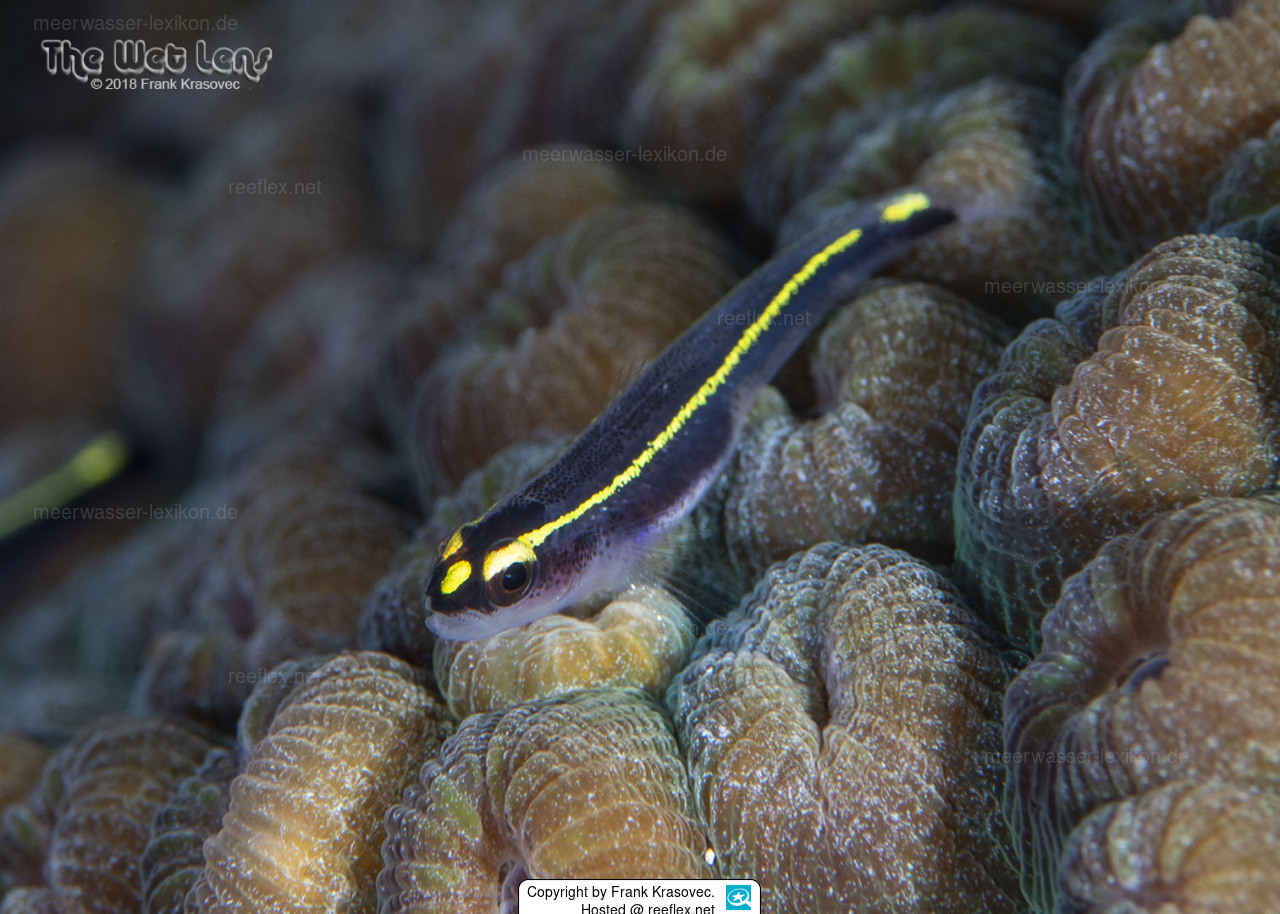
 Frank Krasovec, USA


Info
Elacatinus atronasus (Böhlke & Robins, 1968)
Habitat: Vertical faces of coral ledges, with numerous holes and around undercut ledges.
Short description:
Snout and front of head black, with a long oval yellow spot from just before eye to near mouth; a yellow stripe from top of eye to the base of tail fin, often with a break in that stripe just before the tail fin; a lateral dark stripe, well developed and wide, from the bottom of the pectoral-fin base to lower portion of tail fin, where it forms a distinct oval black spot; top of body dusky; all fins, except tail fin, clear.
Source:
Shorefishes of the Greater Caribbean online information system
Jumping guard
A jumping guard prevents (nocturnal) fish from jumping out.
Wrasses, blennies, hawkfishs and gobies jump out of an unprotected tank in fright if their night rest is disturbed, unfortunately these jumpers are found dried up in the morning on carpets, glass edges or later behind the tank.
https://www.korallenriff.de/en/article/1925_5_Jump_Protection_Solutions_for_Fish_in_the_Aquarium__5_Net_Covers.html
A small night light also helps, as it provides the fish with a means of orientation in the dark!
Synonymised names
Elacatinus atronasum (Böhlke & Robins, 1968) · unaccepted
Gobiosoma atronasum Böhlke & Robins, 1968 · unaccepted
Habitat: Vertical faces of coral ledges, with numerous holes and around undercut ledges.
Short description:
Snout and front of head black, with a long oval yellow spot from just before eye to near mouth; a yellow stripe from top of eye to the base of tail fin, often with a break in that stripe just before the tail fin; a lateral dark stripe, well developed and wide, from the bottom of the pectoral-fin base to lower portion of tail fin, where it forms a distinct oval black spot; top of body dusky; all fins, except tail fin, clear.
Source:
Shorefishes of the Greater Caribbean online information system
Jumping guard
A jumping guard prevents (nocturnal) fish from jumping out.
Wrasses, blennies, hawkfishs and gobies jump out of an unprotected tank in fright if their night rest is disturbed, unfortunately these jumpers are found dried up in the morning on carpets, glass edges or later behind the tank.
https://www.korallenriff.de/en/article/1925_5_Jump_Protection_Solutions_for_Fish_in_the_Aquarium__5_Net_Covers.html
A small night light also helps, as it provides the fish with a means of orientation in the dark!
Synonymised names
Elacatinus atronasum (Böhlke & Robins, 1968) · unaccepted
Gobiosoma atronasum Böhlke & Robins, 1968 · unaccepted

