


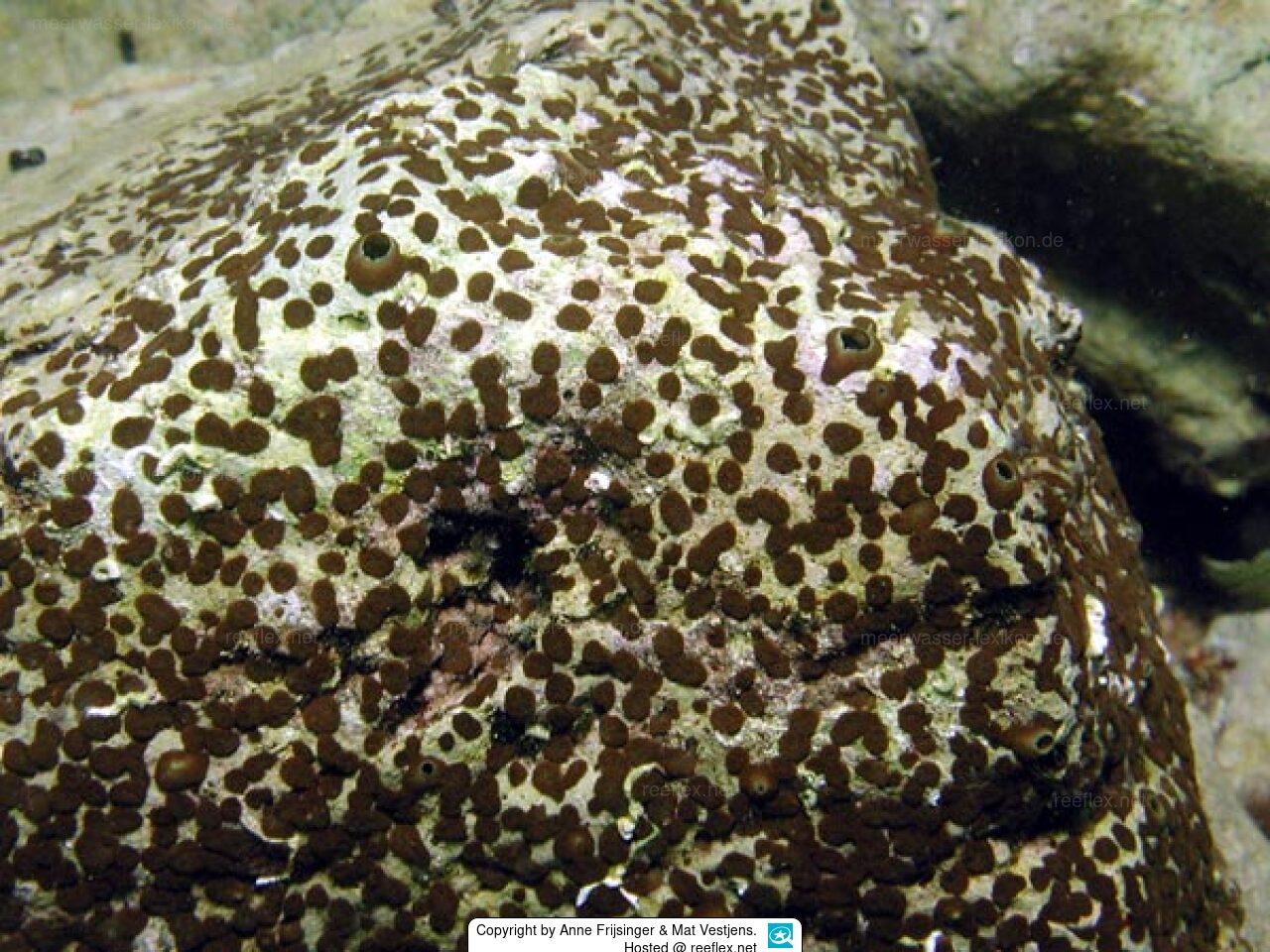
 Anne Frijsinger & Mat Vestjens, Holland


Info
Many photos and brief explanatory information describe the color of this sponge as deep blue, red, purple or brown, the differences are certainly due to the different incidence of sunlight during the day or the depth of the water, so a red tone is no longer recognizable as such from a depth of 10 metres.
See also:
https://scaleo-light.de/wie-verhaelt-sich-licht-unter-wasser-teil-1-lichtspektrum/
Cliona schmidtii occurs on limestone or organic calcareous formations (mussel and snail shells, coral stalks, calcareous algae), where the sponge works its way into the calcareous substrate both mechanically and chemically with the help of its “etching cells”.
When Cliona schmidtii is touched, its soft consistency is noticeable.
Synonyms:
Thoosa istriaca Müller, 1979
Vioa schmidtii Ridley, 1881
See also:
https://scaleo-light.de/wie-verhaelt-sich-licht-unter-wasser-teil-1-lichtspektrum/
Cliona schmidtii occurs on limestone or organic calcareous formations (mussel and snail shells, coral stalks, calcareous algae), where the sponge works its way into the calcareous substrate both mechanically and chemically with the help of its “etching cells”.
When Cliona schmidtii is touched, its soft consistency is noticeable.
Synonyms:
Thoosa istriaca Müller, 1979
Vioa schmidtii Ridley, 1881

