


 ResearchGate

Info
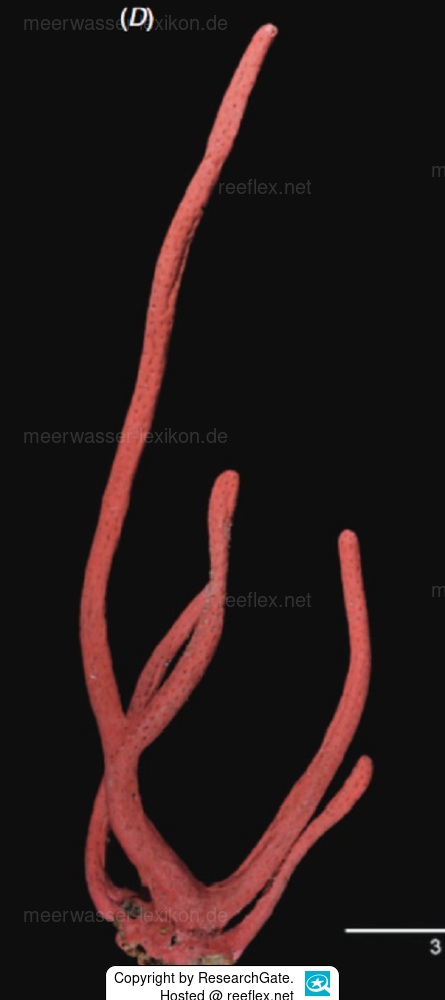
Titanideum frauenfeldii is an azooxanthellate gorgonian that occurs from North Carolina, east coast of the USA to Cuba and the northern Gulf of Mexico.
Colonies of this gorgonian reach up to 60 cm in height and a basal foot diameter of 1.5 cm.
Two distinct fabrmorphs exist, there are those that are uniformly yellow or orange, the latter sometimes with pale yellow calyxes, or pinkish-red, or rarely white, overall a color highlight among gorgonians that distinguishes it from any other member of the West Atlantic Anthothelidae.
At depths from 79/91 meters Titanideum frauenfeldii settles on hard bottom habitats.
Recommendation - the coral should be kept in a species-specific tank.
Feeding
The majority of gorgonians do not have zooxanthellae and do not live off light. Azooxanthellate gorgonians do not host symbiotic algae that produce nutrients and energy through photosynthesis.
The pumps should be switched off before feeding. In order for the gorgonian to survive in the aquarium, each individual polyp must be fed sufficiently, i.e. daily or 3-4 times a week. Without feeding, the gorgonian will not survive in the aquarium. The polyps need a certain amount of time to absorb the food (granules or dust food (Ultramarin, Cyclop Eeze) or frozen food (lobster eggs, mysis)). If shrimp and fish are present, they will try to steal the food, so it is essential to feed these cohabitants beforehand.
Newly introduced gorgonian sticks can be stimulated with a liquid food, e.g., PolypLab Polyp, to encourage the individual polyps to open. Only then can feeding be carried out.
The better the individual polyps take up the food provided, the better the growth and reproduction rates will be.
Azooxanthellate corals eat suspensions, marine snow, microplankton, and other organic matter, which is their natural food.
Synonyms:
Gorgonia suberosa Ellis & Solander, 1786
Solanderia frauenfeldii Kölliker, 1865
Colonies of this gorgonian reach up to 60 cm in height and a basal foot diameter of 1.5 cm.
Two distinct fabrmorphs exist, there are those that are uniformly yellow or orange, the latter sometimes with pale yellow calyxes, or pinkish-red, or rarely white, overall a color highlight among gorgonians that distinguishes it from any other member of the West Atlantic Anthothelidae.
At depths from 79/91 meters Titanideum frauenfeldii settles on hard bottom habitats.
Recommendation - the coral should be kept in a species-specific tank.
Feeding
The majority of gorgonians do not have zooxanthellae and do not live off light. Azooxanthellate gorgonians do not host symbiotic algae that produce nutrients and energy through photosynthesis.
The pumps should be switched off before feeding. In order for the gorgonian to survive in the aquarium, each individual polyp must be fed sufficiently, i.e. daily or 3-4 times a week. Without feeding, the gorgonian will not survive in the aquarium. The polyps need a certain amount of time to absorb the food (granules or dust food (Ultramarin, Cyclop Eeze) or frozen food (lobster eggs, mysis)). If shrimp and fish are present, they will try to steal the food, so it is essential to feed these cohabitants beforehand.
Newly introduced gorgonian sticks can be stimulated with a liquid food, e.g., PolypLab Polyp, to encourage the individual polyps to open. Only then can feeding be carried out.
The better the individual polyps take up the food provided, the better the growth and reproduction rates will be.
Azooxanthellate corals eat suspensions, marine snow, microplankton, and other organic matter, which is their natural food.
Synonyms:
Gorgonia suberosa Ellis & Solander, 1786
Solanderia frauenfeldii Kölliker, 1865


