


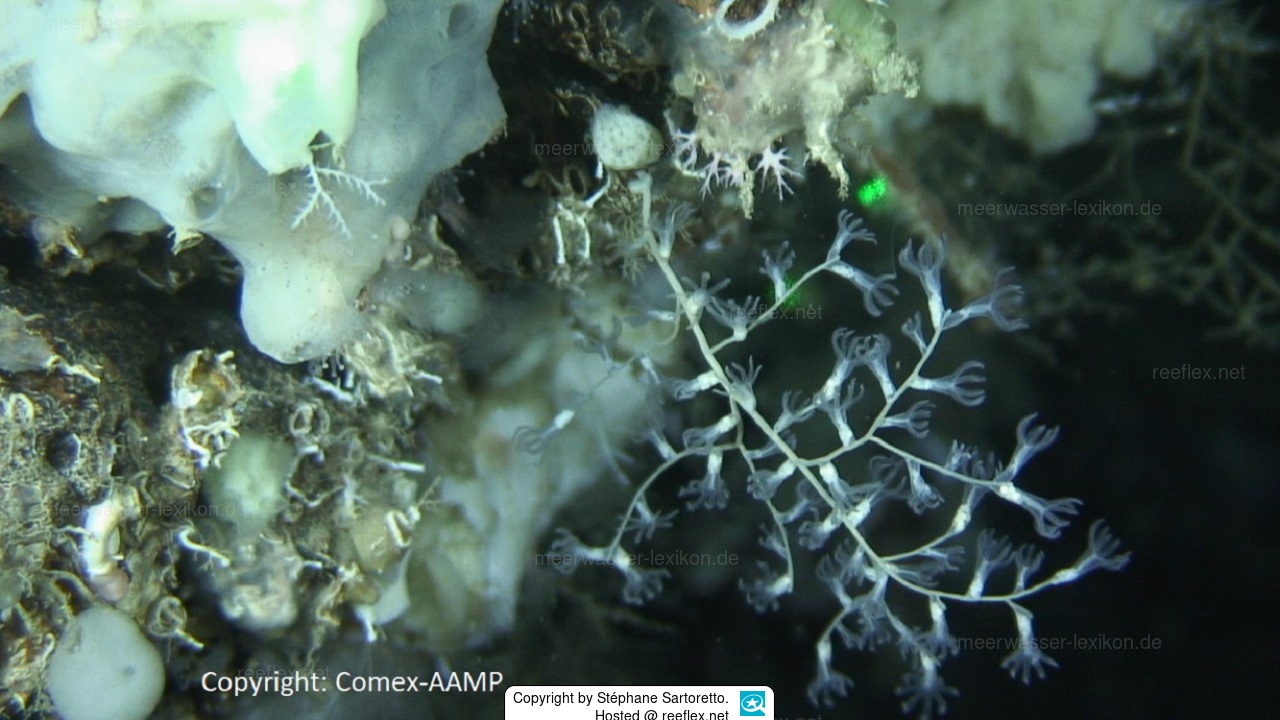
 Dr. Stéphane Sartoretto, Frankreich


Info
A bonsai is a small tree kept in small containers and regularly pruned and shaped.
Etymology.
The species epithet "bonsai" refers to the ancient oriental art of miniaturizing plants, those grown in containers, in allusion to the small and delicate appearance of the colonies of this species compared to the other species of the genus described.
For the gorgonian Dendrobrachia bonsai, the small and delicate appearance comes into play, the coral colonizes deep, rocky walls, along with other gorgonians (Acanthogorgia hirsuta and Muriceides lepida) and can form up to 50 colonies per square meter.
The benthic fauna of such aggregations includes mainly hydroids, gorgonians (Acanthogorgia hirsuta, Bebryce mollis and Muriceides lepida), antipatharians (Leiopathes glaberrima and Parantipathes larix), sponges and brachiopods (Gryphus vitreus).
For its small size, the coral has a sufficient number of polyps for the capture of zooplankton and marine snow, since the gorgonian has no embedded zooxanthellae due to its deep distribution and the lack of light there.
We would like to thank Dr. Stéphane Sartoretto, Laboratoire Environnement Ressources Provence-Azur-Corse, for the great photo of the graceful deep-water gorgonian.
Etymology.
The species epithet "bonsai" refers to the ancient oriental art of miniaturizing plants, those grown in containers, in allusion to the small and delicate appearance of the colonies of this species compared to the other species of the genus described.
For the gorgonian Dendrobrachia bonsai, the small and delicate appearance comes into play, the coral colonizes deep, rocky walls, along with other gorgonians (Acanthogorgia hirsuta and Muriceides lepida) and can form up to 50 colonies per square meter.
The benthic fauna of such aggregations includes mainly hydroids, gorgonians (Acanthogorgia hirsuta, Bebryce mollis and Muriceides lepida), antipatharians (Leiopathes glaberrima and Parantipathes larix), sponges and brachiopods (Gryphus vitreus).
For its small size, the coral has a sufficient number of polyps for the capture of zooplankton and marine snow, since the gorgonian has no embedded zooxanthellae due to its deep distribution and the lack of light there.
We would like to thank Dr. Stéphane Sartoretto, Laboratoire Environnement Ressources Provence-Azur-Corse, for the great photo of the graceful deep-water gorgonian.


