


 Dr. Odalisca Breedy, Panama


Info
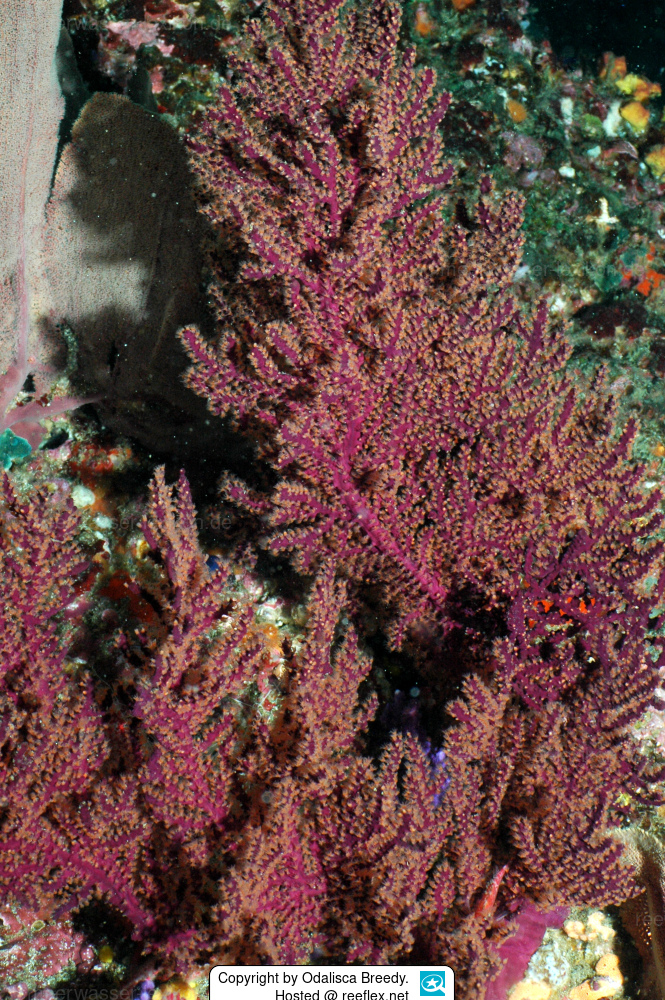
Our special thanks for the great photo of the horn coral Leptogorgia taboguillae go to Dr. Odalisca Breedy (Panama) and Dr. Graham Edgar (Tasmania), who took the picture,
Leptogorgia taboguillae is an azooxanthellate horn coral that only occurs in a few places in the south-east Pacific.
Recommendation - the coral should be kept in a species-specific tank.
Feeding
The majority of gorgonians do not have zooxanthellae and do not live off light. Azooxanthellate gorgonians do not host symbiotic algae that produce nutrients and energy through photosynthesis.
The pumps should be switched off before feeding. In order for the gorgonian to survive in the aquarium, each individual polyp must be fed sufficiently, i.e. daily or 3-4 times a week. Without feeding, the gorgonian will not survive in the aquarium. The polyps need a certain amount of time to absorb the food (granules or dust food (Ultramarin, Cyclop Eeze) or frozen food (lobster eggs, mysis)). If shrimp and fish are present, they will try to steal the food, so it is essential to feed these cohabitants beforehand.
Newly introduced gorgonian sticks can be stimulated with a liquid food, e.g., PolypLab Polyp, to encourage the individual polyps to open. Only then can feeding be carried out.
The better the individual polyps take up the food provided, the better the growth and reproduction rates will be.
Azooxanthellate corals eat suspensions, marine snow, microplankton, and other organic matter, which is their natural food.
Leptogorgia taboguillae resembles some Caribbean species of Pseudopterogorgia in external morphology, but differs markedly from the other species, which have pinnate branching, prominent polyp mounds and thick branches.
Leptogorgia taboguillae is easily recognized by its dark purple color, flat branches and the conspicuous ring of orange sclerites at the base of the polyp tentacles.
Synonyms:
Euplexaura taboguillae Hickson, 1928
Leptogorgia taboguilla (Hickson, 1928)
Leptogorgia taboguillae is an azooxanthellate horn coral that only occurs in a few places in the south-east Pacific.
Recommendation - the coral should be kept in a species-specific tank.
Feeding
The majority of gorgonians do not have zooxanthellae and do not live off light. Azooxanthellate gorgonians do not host symbiotic algae that produce nutrients and energy through photosynthesis.
The pumps should be switched off before feeding. In order for the gorgonian to survive in the aquarium, each individual polyp must be fed sufficiently, i.e. daily or 3-4 times a week. Without feeding, the gorgonian will not survive in the aquarium. The polyps need a certain amount of time to absorb the food (granules or dust food (Ultramarin, Cyclop Eeze) or frozen food (lobster eggs, mysis)). If shrimp and fish are present, they will try to steal the food, so it is essential to feed these cohabitants beforehand.
Newly introduced gorgonian sticks can be stimulated with a liquid food, e.g., PolypLab Polyp, to encourage the individual polyps to open. Only then can feeding be carried out.
The better the individual polyps take up the food provided, the better the growth and reproduction rates will be.
Azooxanthellate corals eat suspensions, marine snow, microplankton, and other organic matter, which is their natural food.
Leptogorgia taboguillae resembles some Caribbean species of Pseudopterogorgia in external morphology, but differs markedly from the other species, which have pinnate branching, prominent polyp mounds and thick branches.
Leptogorgia taboguillae is easily recognized by its dark purple color, flat branches and the conspicuous ring of orange sclerites at the base of the polyp tentacles.
Synonyms:
Euplexaura taboguillae Hickson, 1928
Leptogorgia taboguilla (Hickson, 1928)

