


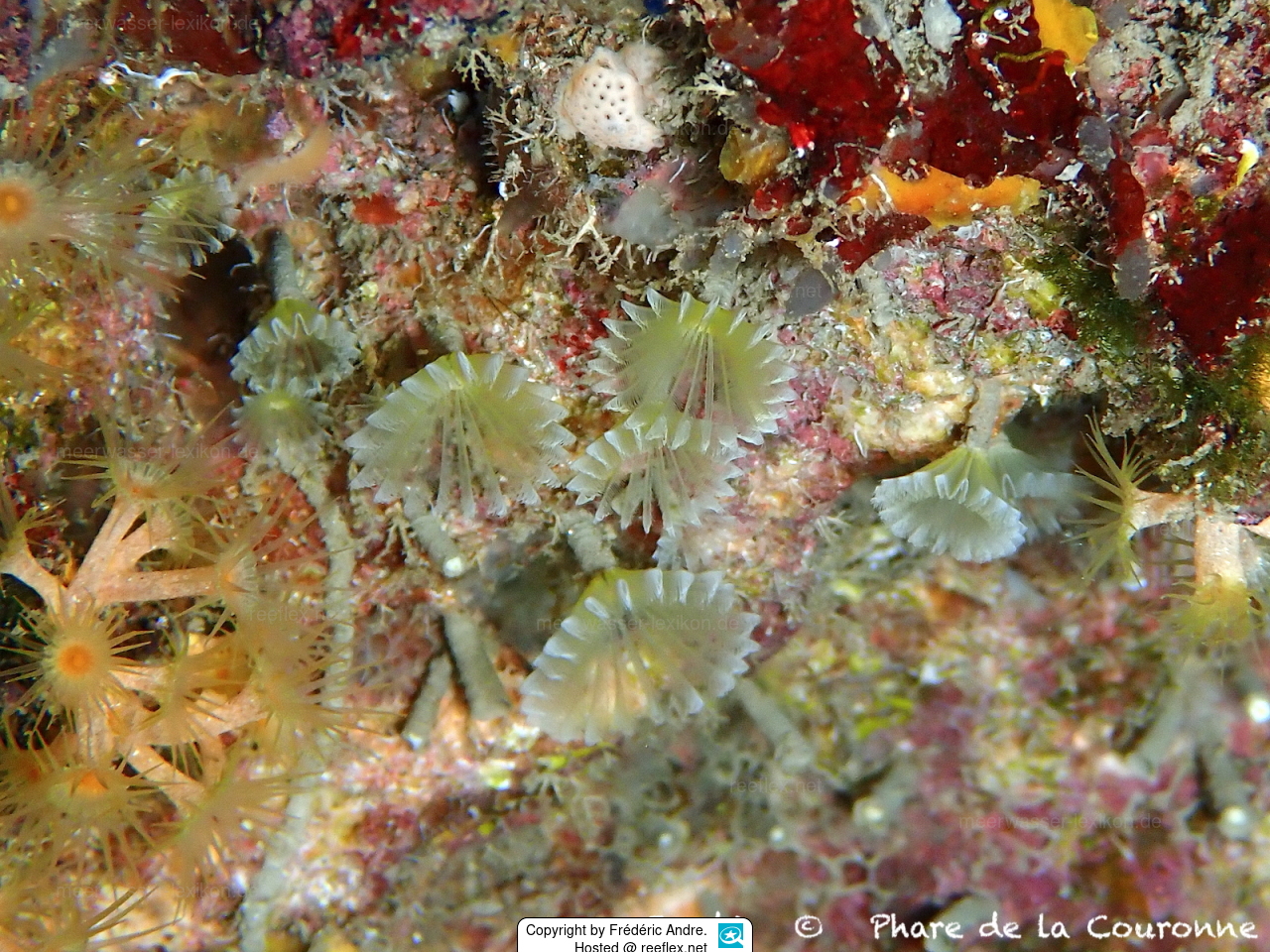
 Frédéric Andre, Frankreich

Info
The genus Hypsicomus is monotypic with Hypsicomus stichophthalmos.
Hypsicomus stichophthalmos is a small, sedentary annelid worm that lives in a cylindrical tube covered with fine gray mud.
This tube, whose diameter does not exceed 2 mm, protrudes only one to two centimeters from the substrate in which it is firmly anchored.
Only the greenish-yellow to whitish gill flag protrudes from the tube. This unfolds into a more or less flared trumpet and reaches a diameter of 15 mm.
It consists of 14 to 30 gill filaments of equal size, arranged in two semicircular lobes.
On the outside, each filament bears two linear rows of eye spots on both sides of the central axis, which are arranged in a characteristic way:
one begins where the other ends.
The body, which is completely protected inside the tube, has 35 to 190 setae, including 9 to 13 thoracic setae.
The small green Sabella is an annelid worm that sometimes occurs in large groups in shady areas.
The gill flap is very sensitive to vibrations and changes in brightness and retreats very quickly into its tube when danger threatens, taking all the flaps of the neighboring worms with it when it occurs in a group.
Synonyms:
Potamilla stichophthalmos (Grube, 1863) · unaccepted (superseded combination)
Sabella (Potamilla) stichophthalmos (Grube, 1863) · unaccepted (superseded combination)
Sabella stichophthalmos Grube, 1863 · unaccepted (superseded original combination)
Hypsicomus stichophthalmos is a small, sedentary annelid worm that lives in a cylindrical tube covered with fine gray mud.
This tube, whose diameter does not exceed 2 mm, protrudes only one to two centimeters from the substrate in which it is firmly anchored.
Only the greenish-yellow to whitish gill flag protrudes from the tube. This unfolds into a more or less flared trumpet and reaches a diameter of 15 mm.
It consists of 14 to 30 gill filaments of equal size, arranged in two semicircular lobes.
On the outside, each filament bears two linear rows of eye spots on both sides of the central axis, which are arranged in a characteristic way:
one begins where the other ends.
The body, which is completely protected inside the tube, has 35 to 190 setae, including 9 to 13 thoracic setae.
The small green Sabella is an annelid worm that sometimes occurs in large groups in shady areas.
The gill flap is very sensitive to vibrations and changes in brightness and retreats very quickly into its tube when danger threatens, taking all the flaps of the neighboring worms with it when it occurs in a group.
Synonyms:
Potamilla stichophthalmos (Grube, 1863) · unaccepted (superseded combination)
Sabella (Potamilla) stichophthalmos (Grube, 1863) · unaccepted (superseded combination)
Sabella stichophthalmos Grube, 1863 · unaccepted (superseded original combination)


