

 Kary Mar

Info
A large Eheim filter can filter up to 28,800 liters of water per day, but this requires a corresponding amount of energy.
The Caribbean vase sponge Spheciospongia vesparium (Lamarck, 1815) achieves almost the same filtration capacity per day, up to 24,000 liters, which is an impressive performance.
Sea sponges are highly efficient filters that process huge amounts of water to filter organic plankton particles, bacteria, and other organic suspended matter from the surrounding water.
So why not replace the electric filter with an efficient sea sponge?
Unfortunately, sea sponges of the required size will not survive permanently in our reef aquariums, as we cannot replace the necessary food particles, which are quickly filtered out, quickly enough and in sufficient quantity and quality (exceptions prove the rule).
Many saltwater aquarists enjoy watching their predominantly zooxanthellate corals grow, which require good light sources, and too much light interferes with the growth of many sea sponges.
The majority of sea sponges prefer low-light areas or even almost light-free caves in order to grow and live.
In addition, some sea sponges have the problem of almost unchecked growth, which in turn can cause problems with other cohabitants.
During sexual reproduction, large sea sponges can release vast amounts of sperm and eggs, so that even large skimmers quickly reach their limit and overflow. Many aquarists have already experienced this when corals spawn.
If you want to keep sponges in your tank, use smaller species that do not grow unchecked and observe them closely.
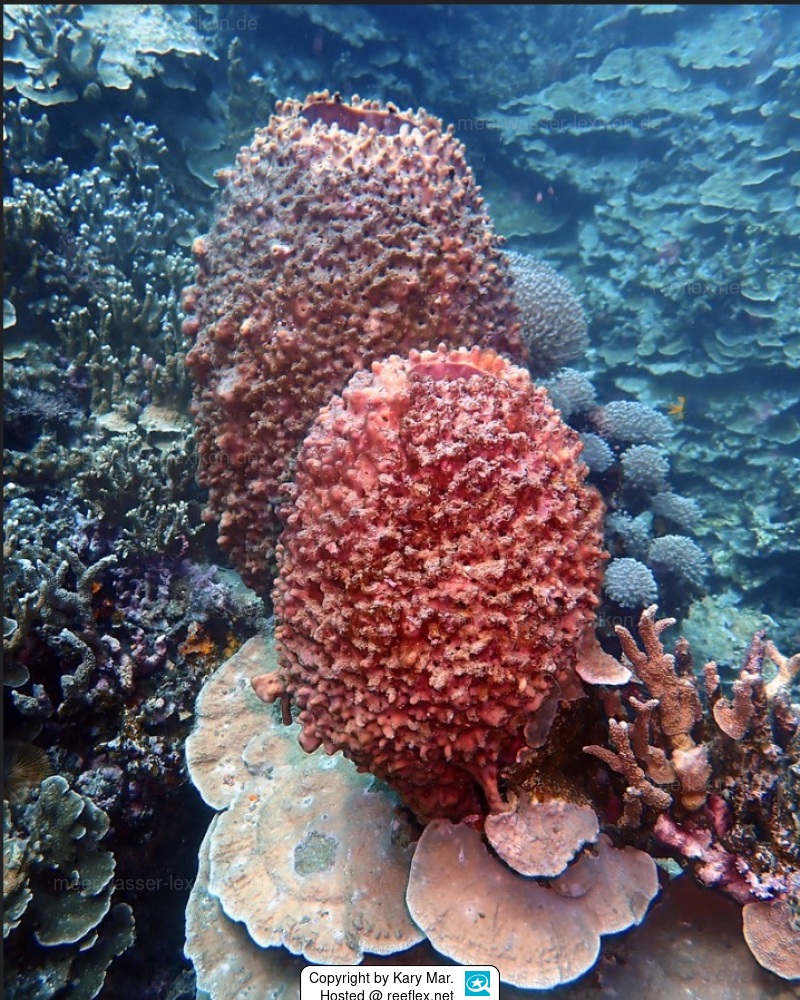
Melophlus sarasinorum is a soccer ball-sized sea sponge in which saponins, for example, have been detected.
In studies in which these sponges were cut open, large quantities of small crabs and worms were counted, and in others large quantities of small brittle stars, an obvious refuge for other marine life that finds protection and food here.
In addition to the reddish color shown, sea sponges also occur in yellowish to orange colors.
Synonyms:
Asteropus sarasinorum (Thiele, 1899) · unaccepted (genus transfer)
Jaspis bandae Brøndsted, 1934 · unaccepted (genus transfer and junior synonym)
Stellettinopsis isis de Laubenfels, 1954 · unaccepted (genus transfer and junior synonym)
The Caribbean vase sponge Spheciospongia vesparium (Lamarck, 1815) achieves almost the same filtration capacity per day, up to 24,000 liters, which is an impressive performance.
Sea sponges are highly efficient filters that process huge amounts of water to filter organic plankton particles, bacteria, and other organic suspended matter from the surrounding water.
So why not replace the electric filter with an efficient sea sponge?
Unfortunately, sea sponges of the required size will not survive permanently in our reef aquariums, as we cannot replace the necessary food particles, which are quickly filtered out, quickly enough and in sufficient quantity and quality (exceptions prove the rule).
Many saltwater aquarists enjoy watching their predominantly zooxanthellate corals grow, which require good light sources, and too much light interferes with the growth of many sea sponges.
The majority of sea sponges prefer low-light areas or even almost light-free caves in order to grow and live.
In addition, some sea sponges have the problem of almost unchecked growth, which in turn can cause problems with other cohabitants.
During sexual reproduction, large sea sponges can release vast amounts of sperm and eggs, so that even large skimmers quickly reach their limit and overflow. Many aquarists have already experienced this when corals spawn.
If you want to keep sponges in your tank, use smaller species that do not grow unchecked and observe them closely.
Melophlus sarasinorum is a soccer ball-sized sea sponge in which saponins, for example, have been detected.
In studies in which these sponges were cut open, large quantities of small crabs and worms were counted, and in others large quantities of small brittle stars, an obvious refuge for other marine life that finds protection and food here.
In addition to the reddish color shown, sea sponges also occur in yellowish to orange colors.
Synonyms:
Asteropus sarasinorum (Thiele, 1899) · unaccepted (genus transfer)
Jaspis bandae Brøndsted, 1934 · unaccepted (genus transfer and junior synonym)
Stellettinopsis isis de Laubenfels, 1954 · unaccepted (genus transfer and junior synonym)

