


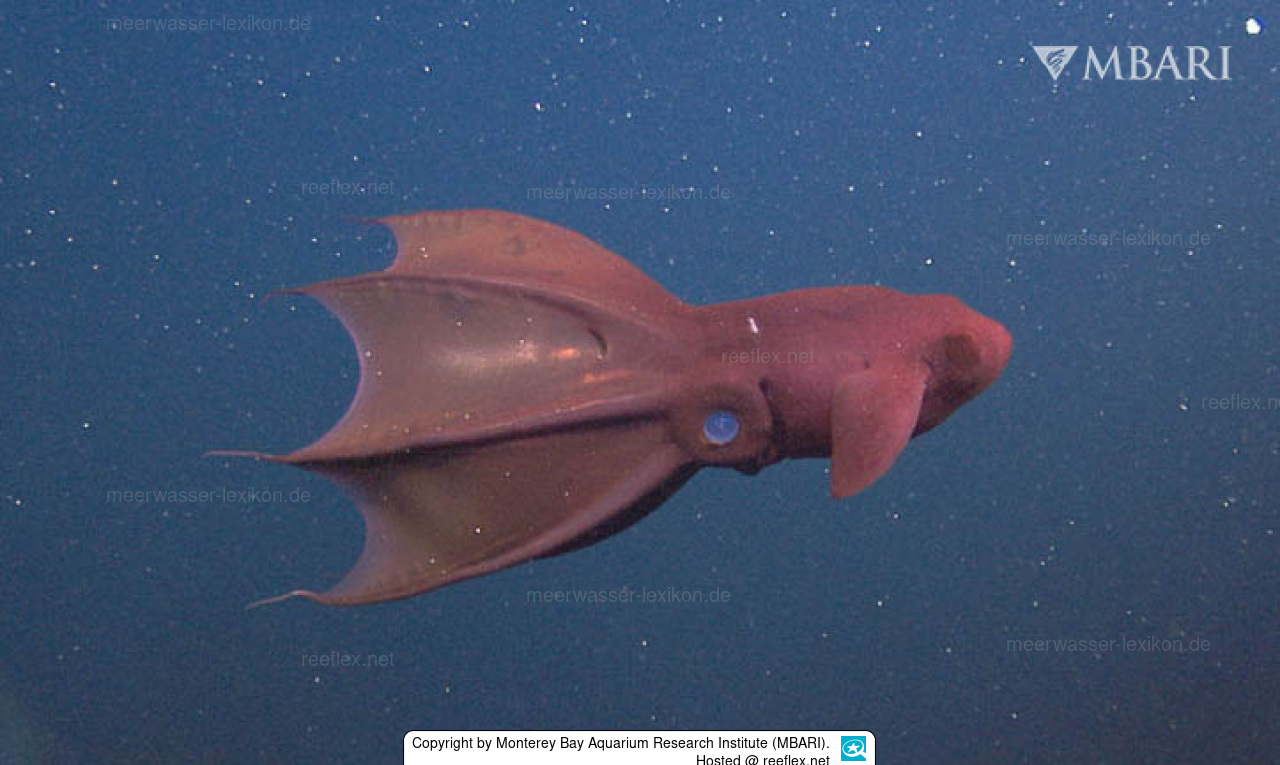
 Monterey Bay Aquarium Research Institute (MBARI), Kalifornien, USA

Info
Vampire—a word that, even in the 21st century, still evokes unease and existential dread in some people. Numerous movies about Dracula and company have depicted vampires’ thirst for blood, and now the Marine Life Encyclopedia has added an entry about a vampire squid....
Does this mean—out of fear of being bitten—we can no longer go swimming along our coasts?
No, that’s nonsense!!
The species name “infernalis,” meaning “hellish,” “devilish,” was given to the squid because of its eerie appearance: the skin stretched between its arms resembles a vampire’s cloak, and its dark coloration and red eyes—similar to those of small squids—combined with its dark, blood-red color and eye color (which sometimes appears blue under different lighting), evoke the image of something “from hell.”
Added to this are the spine-like protrusions on its tentacles.
The common name thus roughly translates to “vampire squid from hell.”
Note:
The name does not describe its diet; despite the dramatic name, the animal does not eat or suck blood or other bodily fluids, but rather feeds on dead organic material from the deep sea—specifically, sinking “sea snow” or detritus.
The vampire squid is a peaceful scavenger that glides through the deep sea, using its long feeding tentacles to collect drifting sediment, known as “sea snow.”
The unique characteristics that distinguish it from other cephalopods help it survive in the darkest depths of the ocean.
The vampire squid also does not squirt ink.
The tips of its tentacles emit a cloud of bioluminescent, sticky mucus that glows for up to 10 minutes—enough time for the squid to escape a potential predator.
Vampire squids are cephalopods that resemble a soccer ball in shape, size, and color.
This has led to the misconception that it sucks blood from its victims. In fact, these squids float peacefully in their deep, dark, and oxygen-poor habitat, waiting for food to come to them—a behavior that differs from that of other squid and octopus species.
Interestingly, the squid can “turn itself inside out” to escape predators.
Potential predators:
Dolphins, sharks, whales, and swordfish
We would like to extend our special thanks to the Monterey Bay Aquarium Research Institute (MBARI) in California, USA, for the unique photo of Vampyroteuthis infernalis.
Synonyms:
Cirroteuthis macrope S. S. Berry, 1911 · unaccepted
Danateuthis schmidti Joubin, 1929 · unaccepted
Hansenoteuthis lucens Joubin, 1929 · unaccepted
Melanoteuthis anderseni Joubin, 1931 · unaccepted (synonym)
Melanoteuthis beebei G. C. Robson, 1929 · unaccepted > junior subjective synonym
Melanoteuthis lucens Joubin, 1912 · unaccepted (synonym)
Melanoteuthis schmidti Joubin, 1929 · unaccepted (synonym)
Retroteuthis pacifica Joubin, 1929 · unaccepted (synonym)
Vampyroteuthis pseudoinfernalis D.-J. Qiu, B.-L. Liu & L.-M. Huang, 2024 · unaccepted > junior subjective synonym
Watasella nigra M. Sasaki, 1920 · unaccepted (synonym)
Credit: © 2000 MBARI
Does this mean—out of fear of being bitten—we can no longer go swimming along our coasts?
No, that’s nonsense!!
The species name “infernalis,” meaning “hellish,” “devilish,” was given to the squid because of its eerie appearance: the skin stretched between its arms resembles a vampire’s cloak, and its dark coloration and red eyes—similar to those of small squids—combined with its dark, blood-red color and eye color (which sometimes appears blue under different lighting), evoke the image of something “from hell.”
Added to this are the spine-like protrusions on its tentacles.
The common name thus roughly translates to “vampire squid from hell.”
Note:
The name does not describe its diet; despite the dramatic name, the animal does not eat or suck blood or other bodily fluids, but rather feeds on dead organic material from the deep sea—specifically, sinking “sea snow” or detritus.
The vampire squid is a peaceful scavenger that glides through the deep sea, using its long feeding tentacles to collect drifting sediment, known as “sea snow.”
The unique characteristics that distinguish it from other cephalopods help it survive in the darkest depths of the ocean.
The vampire squid also does not squirt ink.
The tips of its tentacles emit a cloud of bioluminescent, sticky mucus that glows for up to 10 minutes—enough time for the squid to escape a potential predator.
Vampire squids are cephalopods that resemble a soccer ball in shape, size, and color.
This has led to the misconception that it sucks blood from its victims. In fact, these squids float peacefully in their deep, dark, and oxygen-poor habitat, waiting for food to come to them—a behavior that differs from that of other squid and octopus species.
Interestingly, the squid can “turn itself inside out” to escape predators.
Potential predators:
Dolphins, sharks, whales, and swordfish
We would like to extend our special thanks to the Monterey Bay Aquarium Research Institute (MBARI) in California, USA, for the unique photo of Vampyroteuthis infernalis.
Synonyms:
Cirroteuthis macrope S. S. Berry, 1911 · unaccepted
Danateuthis schmidti Joubin, 1929 · unaccepted
Hansenoteuthis lucens Joubin, 1929 · unaccepted
Melanoteuthis anderseni Joubin, 1931 · unaccepted (synonym)
Melanoteuthis beebei G. C. Robson, 1929 · unaccepted > junior subjective synonym
Melanoteuthis lucens Joubin, 1912 · unaccepted (synonym)
Melanoteuthis schmidti Joubin, 1929 · unaccepted (synonym)
Retroteuthis pacifica Joubin, 1929 · unaccepted (synonym)
Vampyroteuthis pseudoinfernalis D.-J. Qiu, B.-L. Liu & L.-M. Huang, 2024 · unaccepted > junior subjective synonym
Watasella nigra M. Sasaki, 1920 · unaccepted (synonym)
Credit: © 2000 MBARI

