

 ZooKeys

Info
ROV “SuBastian”
Many studies highlight the remarkable diversity of life forms in the deep sea, despite the extreme conditions that prevail there.
This paper describes a new family of gorgonian octocorals, using a taxonomic approach that combines morphological and genetic findings.
The corals were discovered during two expeditions using the ROV “SuBastian” at depths of 360–529 meters on underwater mountains off the island plateau of Isla del Coco / Cocos Island, as well as in three geological formations with extremely low oxygen levels along Costa Rica’s Pacific margin.
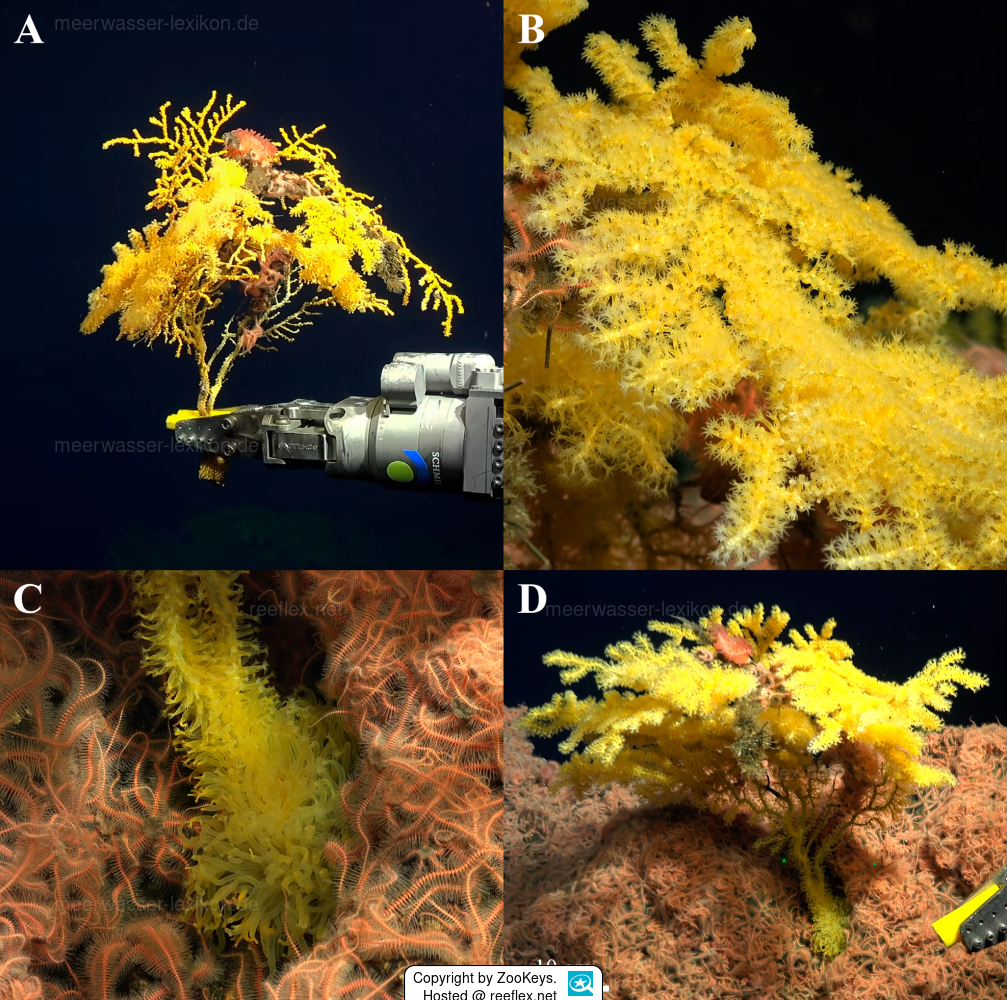
The new family Laurinqueidae is characterized by large, irregularly fan-shaped colonies whose branching is irregularly lateral, dense, and occasionally anastomosing.
The thin coenochym comprises a sclerome consisting of rods and spindles with simple or complex tubercles; the axial sheath features rods and rays.
The polyps are tubular and strikingly elongated, partially retractable into short cylindrical or dome-shaped mounds, and arranged around the branches; they can grow up to 5 cm long.
The anthocodia feature tuberculate rods and spindles arranged in a punctate pattern, as well as an inconspicuous collar.
When alive, the colonies are bright yellow.
Description:
The holotype is a large, irregularly fan-shaped colony with a height of up to 50 cm and a width of up to 60 cm.
The entire colony branches irregularly laterally, densely, approximately in a single plane, and occasionally anastomosing.
The stem is ~3 cm long, has a diameter of 1.5 cm, and is slightly flattened.
It arises from an extensive holdfast and forms several main branches with a diameter of 0.6–1.0 cm.
The branches branch out 20–30 times, forming lateral branches spaced 0.5–6.0 cm apart and with a diameter of 0.1–0.6 cm
The free ends are up to 6 cm long and have a diameter of 0.10–0.15 mm.
The axis is proteaceous, dark brown with concentric layers of gorgonin and a hollow core divided into chambers.
The stem and the attachment disc are covered with elongated, tubular polyps; the attachment disc extends across the substrate beneath the brittle stars.
The attachment disc of the collected colony has a diameter of ~5 cm.
The coenenchyme is thin and features parallel grooves along the main axis and the branches, extending across the entire colony
Variants.
The paratypes consist of a small colony with a single, 4 cm long branch (MZUCR 3892) attached to a rock; a complete colony 25 cm long and 11 cm wide (MZUCR 3088); as well as small fragments (MZUCR 4080, 4022) from larger colonies (Fig.; paratype MZUCR 4022).
All paratypes exhibit consistent sclerite forms, although there are certain variations in size and colony morphology.
The colonies observed at Las Gemelas I and II were larger and more fern-like than those at Seamount 6.
Eggs were found in the specimens collected at Las Gemelas II.
As can be seen particularly clearly in photos C and D, the base of the corals is “teeming” with small snake starfish.
Etymology.
Laurinquë: means “golden tree” in the Elvish language Quenya (The Lord of the Rings, Tolkien 1955)—a reference to the bright yellow, tree-like colonies.
The golden octocoral gardens set against fields of snake stars are reminiscent of the mystical world of the Elves, where they spoke Quenya, their ancient language (“The Lord of the Rings,” Tolkien 1955; “The Silmarillion,” Tolkien 1977).
Reference:
Breedy O, McFadden CS, Murillo-Cruz C, Yánez-Suárez A-B, Robert K, Quattrini AM (2026) A coral among stars: A new octocoral family (Anthozoa, Octocorallia, Malacalcyonacea) from seamounts in the tropical eastern Pacific. ZooKeys 1283: 253-272. https://doi.org/10.3897/zookeys.1283.191899
This is an open access article distributed under the terms of the Creative Commons Attribution License (CC BY 4.0), which permits unrestricted use, distribution, and reproduction in any medium, provided the original author and source are credited.
Many studies highlight the remarkable diversity of life forms in the deep sea, despite the extreme conditions that prevail there.
This paper describes a new family of gorgonian octocorals, using a taxonomic approach that combines morphological and genetic findings.
The corals were discovered during two expeditions using the ROV “SuBastian” at depths of 360–529 meters on underwater mountains off the island plateau of Isla del Coco / Cocos Island, as well as in three geological formations with extremely low oxygen levels along Costa Rica’s Pacific margin.
The new family Laurinqueidae is characterized by large, irregularly fan-shaped colonies whose branching is irregularly lateral, dense, and occasionally anastomosing.
The thin coenochym comprises a sclerome consisting of rods and spindles with simple or complex tubercles; the axial sheath features rods and rays.
The polyps are tubular and strikingly elongated, partially retractable into short cylindrical or dome-shaped mounds, and arranged around the branches; they can grow up to 5 cm long.
The anthocodia feature tuberculate rods and spindles arranged in a punctate pattern, as well as an inconspicuous collar.
When alive, the colonies are bright yellow.
Description:
The holotype is a large, irregularly fan-shaped colony with a height of up to 50 cm and a width of up to 60 cm.
The entire colony branches irregularly laterally, densely, approximately in a single plane, and occasionally anastomosing.
The stem is ~3 cm long, has a diameter of 1.5 cm, and is slightly flattened.
It arises from an extensive holdfast and forms several main branches with a diameter of 0.6–1.0 cm.
The branches branch out 20–30 times, forming lateral branches spaced 0.5–6.0 cm apart and with a diameter of 0.1–0.6 cm
The free ends are up to 6 cm long and have a diameter of 0.10–0.15 mm.
The axis is proteaceous, dark brown with concentric layers of gorgonin and a hollow core divided into chambers.
The stem and the attachment disc are covered with elongated, tubular polyps; the attachment disc extends across the substrate beneath the brittle stars.
The attachment disc of the collected colony has a diameter of ~5 cm.
The coenenchyme is thin and features parallel grooves along the main axis and the branches, extending across the entire colony
Variants.
The paratypes consist of a small colony with a single, 4 cm long branch (MZUCR 3892) attached to a rock; a complete colony 25 cm long and 11 cm wide (MZUCR 3088); as well as small fragments (MZUCR 4080, 4022) from larger colonies (Fig.; paratype MZUCR 4022).
All paratypes exhibit consistent sclerite forms, although there are certain variations in size and colony morphology.
The colonies observed at Las Gemelas I and II were larger and more fern-like than those at Seamount 6.
Eggs were found in the specimens collected at Las Gemelas II.
As can be seen particularly clearly in photos C and D, the base of the corals is “teeming” with small snake starfish.
Etymology.
Laurinquë: means “golden tree” in the Elvish language Quenya (The Lord of the Rings, Tolkien 1955)—a reference to the bright yellow, tree-like colonies.
The golden octocoral gardens set against fields of snake stars are reminiscent of the mystical world of the Elves, where they spoke Quenya, their ancient language (“The Lord of the Rings,” Tolkien 1955; “The Silmarillion,” Tolkien 1977).
Reference:
Breedy O, McFadden CS, Murillo-Cruz C, Yánez-Suárez A-B, Robert K, Quattrini AM (2026) A coral among stars: A new octocoral family (Anthozoa, Octocorallia, Malacalcyonacea) from seamounts in the tropical eastern Pacific. ZooKeys 1283: 253-272. https://doi.org/10.3897/zookeys.1283.191899
This is an open access article distributed under the terms of the Creative Commons Attribution License (CC BY 4.0), which permits unrestricted use, distribution, and reproduction in any medium, provided the original author and source are credited.


