


 Dr. John Turnbull, Marine Explorer, Australien


Info
Pseudolabrus luculentus (Richardson, 1848)
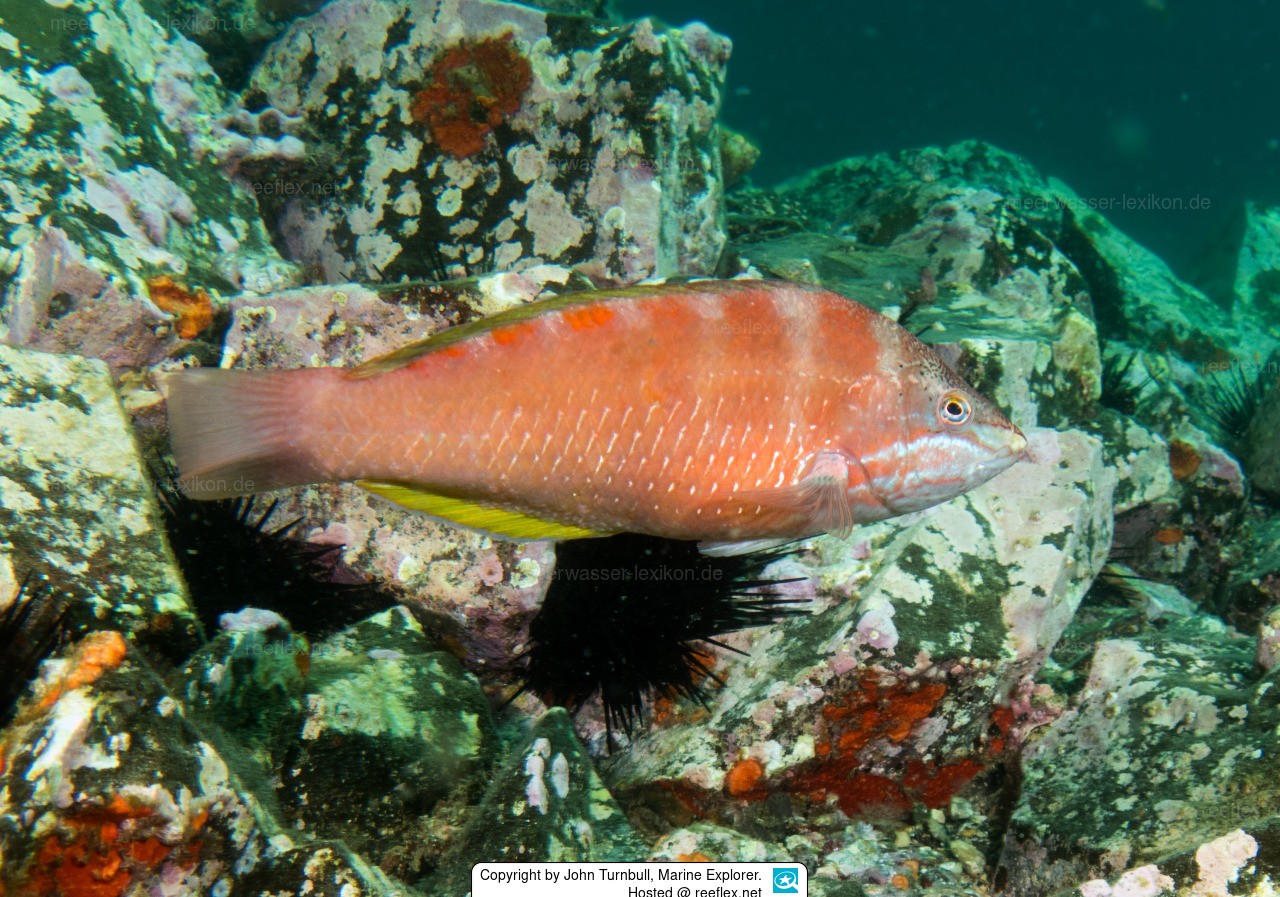
Pseudolabrus luculentus lives in coastal and offshore reefs at depths of up to about 50 meters.Females are orange with white horizontal stripes on the head and under the eye, and numerous diagonal white spots or lines are visible on the lower half of the body. The dorsal and anal fins of females are yellowish.
Male wrasse are intensely reddish and have black and white spots along the base of the dorsal fin.Juveniles are known to clean parasites from other fishes.
Like other wrasses, the Luculent Wrasse is variable in colour depending on its life stage and sex.Pseudolabrus luculentus is specifically imported, so we assume that our readers have a wealth of information on keeping them.
Etymology:
The specific name is from the Latin luculentus (= full of light, bright, splendid), presumably in reference to the "oblique descending silvery bar" on the base of each scale below the lateral line that "belongs to the integument beneath the scale and shines through".
Jumping guard
A jumping guard prevents (nocturnal) fish from jumping out.
Wrasses, blennies, hawkfishs and gobies jump out of an unprotected tank in fright if their night rest is disturbed, unfortunately these jumpers are found dried up in the morning on carpets, glass edges or later behind the tank.
https://www.korallenriff.de/en/article/1925_5_Jump_Protection_Solutions_for_Fish_in_the_Aquarium__5_Net_Covers.html
A small night light also helps, as it provides the fish with a means of orientation in the dark!
Synonymised names
Labrichthys luculenta (Richardson, 1848) · unaccepted
Labrus luculentus Richardson, 1848 · unaccepted
Tautoga luculenta Richardson, 1848 · unaccepted
Pseudolabrus luculentus lives in coastal and offshore reefs at depths of up to about 50 meters.Females are orange with white horizontal stripes on the head and under the eye, and numerous diagonal white spots or lines are visible on the lower half of the body. The dorsal and anal fins of females are yellowish.
Male wrasse are intensely reddish and have black and white spots along the base of the dorsal fin.Juveniles are known to clean parasites from other fishes.
Like other wrasses, the Luculent Wrasse is variable in colour depending on its life stage and sex.Pseudolabrus luculentus is specifically imported, so we assume that our readers have a wealth of information on keeping them.
Etymology:
The specific name is from the Latin luculentus (= full of light, bright, splendid), presumably in reference to the "oblique descending silvery bar" on the base of each scale below the lateral line that "belongs to the integument beneath the scale and shines through".
Jumping guard
A jumping guard prevents (nocturnal) fish from jumping out.
Wrasses, blennies, hawkfishs and gobies jump out of an unprotected tank in fright if their night rest is disturbed, unfortunately these jumpers are found dried up in the morning on carpets, glass edges or later behind the tank.
https://www.korallenriff.de/en/article/1925_5_Jump_Protection_Solutions_for_Fish_in_the_Aquarium__5_Net_Covers.html
A small night light also helps, as it provides the fish with a means of orientation in the dark!
Synonymised names
Labrichthys luculenta (Richardson, 1848) · unaccepted
Labrus luculentus Richardson, 1848 · unaccepted
Tautoga luculenta Richardson, 1848 · unaccepted


