




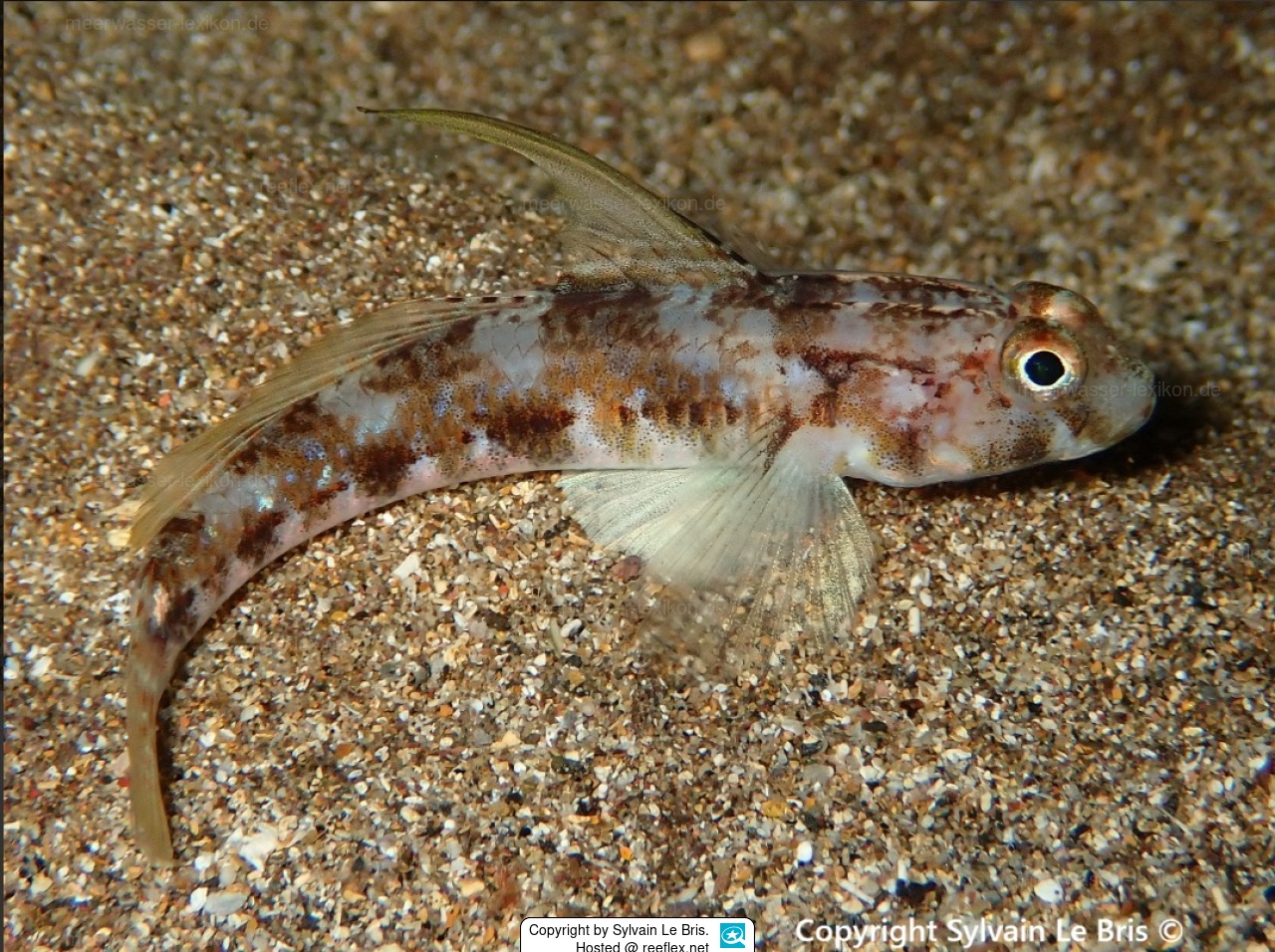
 Sylvain Le Bris, Frankreich


Info
Gobius roulei de Buen, 1928
Occurs inshore in the Mediterranean but found in deeper waters off Portugal:
Length: 6 - 8 cm.
Colouration
Sandy colored with a row of dark spots (black surrounded by brown). Brown reticulation on back. First ray of D1 with dark transverse stripes. No dark spot on D1. Spawning males (--> photograph) not black like G. niger.
Description
In adult males D1 sickle-shaped and prolonged during spawning (similar to G. niger). Nape and cheek naked. Anterior nostril with triangular lappet.
Species from Ibiza differ somewhat from those of the Adriatic Sea.
Food
Carnivorous; mobile benthic fauna, including bivalves, gammariden, gastropods, polychaets, pagurids, mysids, gammarids and fishes.
Reproduction
Spawning season: Aprit to August. Reproductive behaviour: goby pattern. One female has 1.200 - 8.000 eggs.
Nests are built under stones or empty shells of mussels. Up to 7 years old.
Habitat
4 - 25? m. Sandy bottoms. Avoids polluted areas (in contrast to G. niger). Settles under shells of bivalves, flat stones or other objects. In certain regions (e.g. northern Adriatic Sea) quite common.
Jumping guard
A jumping guard prevents (nocturnal) fish from jumping out.
Wrasses, blennies, hawkfishs and gobies jump out of an unprotected tank in fright if their night rest is disturbed, unfortunately these jumpers are found dried up in the morning on carpets, glass edges or later behind the tank.
https://www.korallenriff.de/en/article/1925_5_Jump_Protection_Solutions_for_Fish_in_the_Aquarium__5_Net_Covers.html
A small night light also helps, as it provides the fish with a means of orientation in the dark!
Occurs inshore in the Mediterranean but found in deeper waters off Portugal:
Length: 6 - 8 cm.
Colouration
Sandy colored with a row of dark spots (black surrounded by brown). Brown reticulation on back. First ray of D1 with dark transverse stripes. No dark spot on D1. Spawning males (--> photograph) not black like G. niger.
Description
In adult males D1 sickle-shaped and prolonged during spawning (similar to G. niger). Nape and cheek naked. Anterior nostril with triangular lappet.
Species from Ibiza differ somewhat from those of the Adriatic Sea.
Food
Carnivorous; mobile benthic fauna, including bivalves, gammariden, gastropods, polychaets, pagurids, mysids, gammarids and fishes.
Reproduction
Spawning season: Aprit to August. Reproductive behaviour: goby pattern. One female has 1.200 - 8.000 eggs.
Nests are built under stones or empty shells of mussels. Up to 7 years old.
Habitat
4 - 25? m. Sandy bottoms. Avoids polluted areas (in contrast to G. niger). Settles under shells of bivalves, flat stones or other objects. In certain regions (e.g. northern Adriatic Sea) quite common.
Jumping guard
A jumping guard prevents (nocturnal) fish from jumping out.
Wrasses, blennies, hawkfishs and gobies jump out of an unprotected tank in fright if their night rest is disturbed, unfortunately these jumpers are found dried up in the morning on carpets, glass edges or later behind the tank.
https://www.korallenriff.de/en/article/1925_5_Jump_Protection_Solutions_for_Fish_in_the_Aquarium__5_Net_Covers.html
A small night light also helps, as it provides the fish with a means of orientation in the dark!


