Kathleen Boyd


Info
Cyerce cristallina (Trinchese, 1881)
Snorkellers and divers may also encounter this sacoglossan sea slug in the Mediterranean, but it occurs mainly in the Caribbean, the USA and Canada.
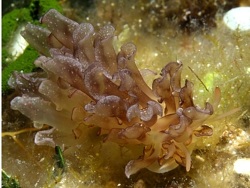
The body of Cyerce cristallina and the inner side of the foot are a deep, opaque red. On the head there are two oval, translucent, clear patches extending from the eye to the base of the rhinophores, and a further U-shaped, translucent, clear patch on the dorsal midline above the pericardial hump. These three translucent patches leave a red, cross-shaped pattern on the head.
The margin of the foot is translucent and clear. The larger branch of the bifurcate rhinophores is red, while the smaller branch is translucent and clear with a reddish tip. The oral tentacles are translucent. The cerata are translucent with a red marking along the midline, which can range from a broad band running the length of the ceras to just a single red spot at the tip. On either side of the red tip, the margin of the cerata is opaque white, with white spots scattered over the back of the cerata.
The foot has rounded anterior corners, and its front edge is transversely grooved. The sole of the foot is crossed by a deep transverse furrow at the end of the first third of the body. Some descriptions report an olive-green band along the sides of the body, which may be related to diet, although this is not clear from published descriptions. The anal papillae are located on the right side behind the eye and just in front of the pericardium.
The spawn is a flat spiral ribbon containing white eggs 0.06 mm in diameter. Grows to about 35 mm in length.
Whereas slugs of the genus Janolus feed on bryozoans, Cyerce feeds on filamentous algae.
Synonymised names
Cyerce iheringi Pelseneer, 1892 · unaccepted > junior subjective synonym
Lobiancoia cristallina Trinchese, 1881 · unaccepted
Snorkellers and divers may also encounter this sacoglossan sea slug in the Mediterranean, but it occurs mainly in the Caribbean, the USA and Canada.
The body of Cyerce cristallina and the inner side of the foot are a deep, opaque red. On the head there are two oval, translucent, clear patches extending from the eye to the base of the rhinophores, and a further U-shaped, translucent, clear patch on the dorsal midline above the pericardial hump. These three translucent patches leave a red, cross-shaped pattern on the head.
The margin of the foot is translucent and clear. The larger branch of the bifurcate rhinophores is red, while the smaller branch is translucent and clear with a reddish tip. The oral tentacles are translucent. The cerata are translucent with a red marking along the midline, which can range from a broad band running the length of the ceras to just a single red spot at the tip. On either side of the red tip, the margin of the cerata is opaque white, with white spots scattered over the back of the cerata.
The foot has rounded anterior corners, and its front edge is transversely grooved. The sole of the foot is crossed by a deep transverse furrow at the end of the first third of the body. Some descriptions report an olive-green band along the sides of the body, which may be related to diet, although this is not clear from published descriptions. The anal papillae are located on the right side behind the eye and just in front of the pericardium.
The spawn is a flat spiral ribbon containing white eggs 0.06 mm in diameter. Grows to about 35 mm in length.
Whereas slugs of the genus Janolus feed on bryozoans, Cyerce feeds on filamentous algae.
Synonymised names
Cyerce iheringi Pelseneer, 1892 · unaccepted > junior subjective synonym
Lobiancoia cristallina Trinchese, 1881 · unaccepted