


 iNaturalist Open Source Software


Info
Under optimal conditions, with sufficient and continuous food supply, absence of predators, and no excessive pollution of the waters (including microplastics!), Spondylus limbatus can reach a maximum length of 25 cm and a maximum width of 21 cm.
The mussel is considered to be quite common and relatively widespread in its habitats, and the IUCN Red List of Threatened Species does not currently monitor the large mussel.
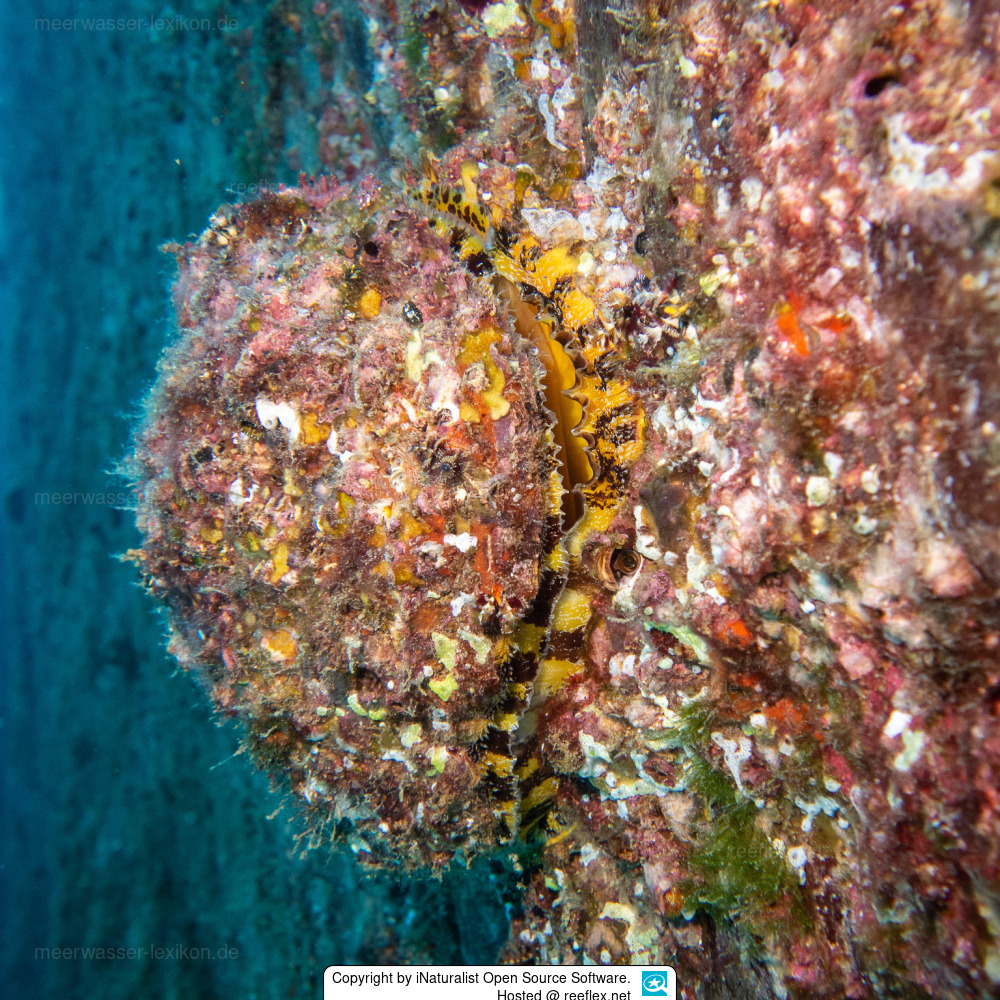
The shell of the mussel is solidly built and oval in shape, with radial lines on its outer surface featuring short, spatula-shaped or pointed spines, which are worn to varying degrees in older and larger animals.
The marginal spines are fine and numerous.
However, the mussel can exhibit considerable variability in shell shape, ranging from irregularly rounded to distorted.
The right valve also has concentric layers around the attachment area, which can be quite extensive.
The hinge teeth of the shell are robust and thick, brown in the left valve and white in the right valve.
Color:
The outside of the shell is pinkish-red, purple to orange, and the inside is white with a purple-red edge, making the shell easy to identify.
Habitats:
Spondylus limbatus is found on solid substrates in reefs and on other mussel shells.
Biology:
Spondylus limbatus is a dioecious species and reproduces sexually by spawning with external fertilization.
The hinge teeth are generally more robust, larger, and brown, and the adductor muscle scar is deeply indented; the spines also differ in shape and arrangement.
If the mussel still has its right valve, it may have a broad base, which distinguishes it from related species.
The sculpture pattern of the ventral margin consists of fine and numerous notches.
Confusion:
While dark and intense purple tones are characteristic of Spondylus limbatus, predominantly orange and reddish tones can lead to confusion with Spondylus crassisquama.
Synonyms:
Spondylus calcifer P. P. Carpenter, 1857 · unaccepted > junior subjective synonym
Spondylus coccineus Lamarck, 1819 · unaccepted (invalid: junior homonym of S....)
Spondylus lamarckii sensu P. P. Carpenter, 1857 · unaccepted (misapplication)
Spondylus punicus F. R. Bernard, Cai & B. Morton, 1993 · unaccepted
Spondylus radula Reeve, 1856 · unaccepted (invalid: junior homonym of...)
Spondylus smithi Fulton, 1915 · unaccepted
The mussel is considered to be quite common and relatively widespread in its habitats, and the IUCN Red List of Threatened Species does not currently monitor the large mussel.
The shell of the mussel is solidly built and oval in shape, with radial lines on its outer surface featuring short, spatula-shaped or pointed spines, which are worn to varying degrees in older and larger animals.
The marginal spines are fine and numerous.
However, the mussel can exhibit considerable variability in shell shape, ranging from irregularly rounded to distorted.
The right valve also has concentric layers around the attachment area, which can be quite extensive.
The hinge teeth of the shell are robust and thick, brown in the left valve and white in the right valve.
Color:
The outside of the shell is pinkish-red, purple to orange, and the inside is white with a purple-red edge, making the shell easy to identify.
Habitats:
Spondylus limbatus is found on solid substrates in reefs and on other mussel shells.
Biology:
Spondylus limbatus is a dioecious species and reproduces sexually by spawning with external fertilization.
The hinge teeth are generally more robust, larger, and brown, and the adductor muscle scar is deeply indented; the spines also differ in shape and arrangement.
If the mussel still has its right valve, it may have a broad base, which distinguishes it from related species.
The sculpture pattern of the ventral margin consists of fine and numerous notches.
Confusion:
While dark and intense purple tones are characteristic of Spondylus limbatus, predominantly orange and reddish tones can lead to confusion with Spondylus crassisquama.
Synonyms:
Spondylus calcifer P. P. Carpenter, 1857 · unaccepted > junior subjective synonym
Spondylus coccineus Lamarck, 1819 · unaccepted (invalid: junior homonym of S....)
Spondylus lamarckii sensu P. P. Carpenter, 1857 · unaccepted (misapplication)
Spondylus punicus F. R. Bernard, Cai & B. Morton, 1993 · unaccepted
Spondylus radula Reeve, 1856 · unaccepted (invalid: junior homonym of...)
Spondylus smithi Fulton, 1915 · unaccepted

