


 Dr. Sergey V. Bogorodsky, Russland


Info
The chosen English name “Elusive Cardinalfish” translates to “The Hard-to-Find Cardinalfish” in German, a reference to the water depth at which this species is found.
In the species’ initial description from 2020, Apogon fugax was recorded at depths ranging from 54 to 129 meters; the five individuals measured just under 6 cm.
The holotype was caught off Jizan in southern Saudi Arabia in the Red Sea at a depth of 60–67 meters; two paratypes were caught off Myanmar at depths of 54 and 129 meters; and two paratypes were caught off Western Australia at a depth of 166 meters.
The specimen from the Red Sea was caught together with two species that inhabit such habitats, namely Apogonichthyoides pseudotaeniatus (Gon) and Lutjanus argentimaculatus (Forsskål), and the two specimens from Myanmar were caught in the early evening (between 4:50 p.m. and 6:30 p.m.), possibly as they emerged from their daytime hiding places to feed.
In 2025, Apogon fugax was landed near the Indian state of Kerala, India, during deep-sea shrimp fishing at a significantly greater depth using a trawl net in an area between 250–340 meters.
The fish discovered here were also significantly larger, reaching 75.62–84.28 mm SL.
Apogon fugax exhibits characteristics consistent with the species group of the “Talboti lookalikes” (i.e., Apogon caudicinctus, Apogon dianthus, and Apogon soloriens) as well as with Apogon rubrifuscus and Apogon deetsie.
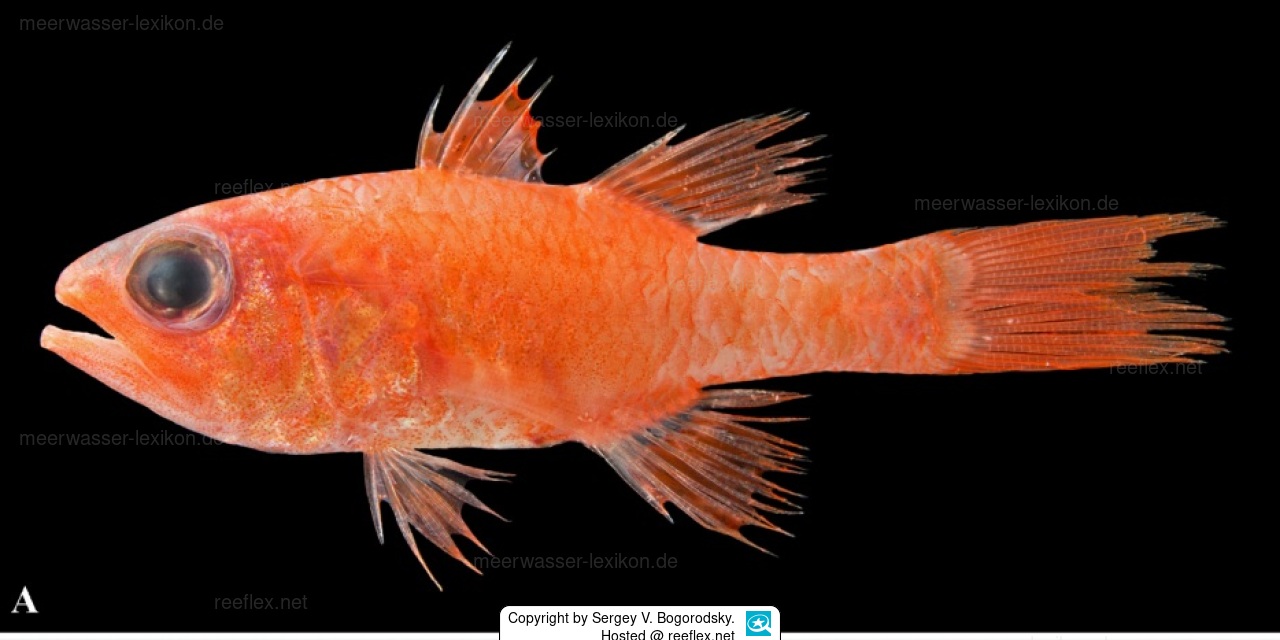
Apogon fugax is uniformly reddish-orange in color, with the edges of the scales highlighted by larger chromatophores.
Five vertically aligned black spots are located on the membrane between the 2nd and 3rd dorsal fin rays; and faint, dark spots of varying sizes are distributed across the caudal peduncle immediately before the base of the caudal fin.
Etymology.
This species bears the name “fugax” (Latin for “elusive”), as it eludes discovery despite intensive collection efforts in the Red Sea and the Indian Ocean.
We would like to thank Dr. Sergey V. Bogorodsky for the first photograph of this deep-sea cardinalfish species.
In the species’ initial description from 2020, Apogon fugax was recorded at depths ranging from 54 to 129 meters; the five individuals measured just under 6 cm.
The holotype was caught off Jizan in southern Saudi Arabia in the Red Sea at a depth of 60–67 meters; two paratypes were caught off Myanmar at depths of 54 and 129 meters; and two paratypes were caught off Western Australia at a depth of 166 meters.
The specimen from the Red Sea was caught together with two species that inhabit such habitats, namely Apogonichthyoides pseudotaeniatus (Gon) and Lutjanus argentimaculatus (Forsskål), and the two specimens from Myanmar were caught in the early evening (between 4:50 p.m. and 6:30 p.m.), possibly as they emerged from their daytime hiding places to feed.
In 2025, Apogon fugax was landed near the Indian state of Kerala, India, during deep-sea shrimp fishing at a significantly greater depth using a trawl net in an area between 250–340 meters.
The fish discovered here were also significantly larger, reaching 75.62–84.28 mm SL.
Apogon fugax exhibits characteristics consistent with the species group of the “Talboti lookalikes” (i.e., Apogon caudicinctus, Apogon dianthus, and Apogon soloriens) as well as with Apogon rubrifuscus and Apogon deetsie.
Apogon fugax is uniformly reddish-orange in color, with the edges of the scales highlighted by larger chromatophores.
Five vertically aligned black spots are located on the membrane between the 2nd and 3rd dorsal fin rays; and faint, dark spots of varying sizes are distributed across the caudal peduncle immediately before the base of the caudal fin.
Etymology.
This species bears the name “fugax” (Latin for “elusive”), as it eludes discovery despite intensive collection efforts in the Red Sea and the Indian Ocean.
We would like to thank Dr. Sergey V. Bogorodsky for the first photograph of this deep-sea cardinalfish species.

